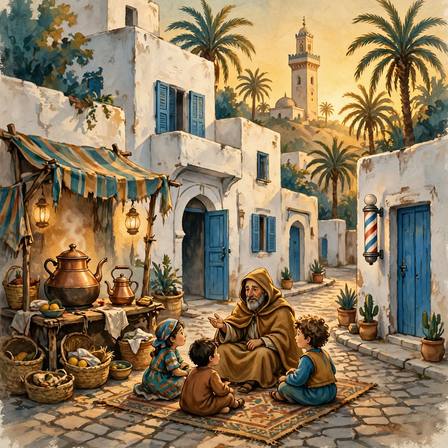
Season 96 · Episode 1 — the opening of the Tunisian shelf of KacheliTV World Classics: folk tales from Tunisia, read aloud in fresh English translations made for this programme.
Disclosure: this performance is narrated by AI-generated voices.
THE BOOKS BEHIND THIS EPISODE
Both sources are collections by Dr Hans Stumme of Leipzig. The tales of the city of Tunis come from his Tunisische Märchen und Gedichte — Tunisian Tales and Poems (Leipzig, 1893), tales and poems in the Arabic dialect of the city of Tunis, printed with his own translation. The tales of the south come from his Märchen der Berbern von Tamazratt in Südtunisien — Tales of the Berbers of Tamazratt in Southern Tunisia (Leipzig, 1900), twenty-six pieces in the Berber tongue of Tamazratt which Stumme recorded in the city of Tunis in March 1897 from two men of Tamazratt, porters and folk singers, named Muhammed and Mhammed. The tales are told in the order they stand in their books, and every piece of both books was read and screened under this shelf's content rule before anything was built: of the fifty-one prose pieces in the two books, seven are told here. The rest stand named, each with its reason, in the shelf register — the excluded pieces are not told, and no completeness is claimed for either book.
IN THIS EPISODE
0:36 Introduction
2:09 Abu Nowas and His Wife — the shared death of Abu Nowas and his wife Nur-Essbach, though neither of them dies at all: a jest for Harun Arraschid that ends in laughter and a thousand gold pieces.
12:04 Dschuha and the Washing Kettle — the borrowed kettle that gave birth to a little one, and, borrowed again, died in childbed; the judge rules for Dschuha.
14:36 Dschuha and the Treasure — a calf's hide sold for a single heller, and the pierced coin that marks a chest of gold.
16:59 The Merchant and the Barber — the Tunis merchant who mocked the barber's trade, the shipwreck, and the steamer's cargo that made them both rich; people called them the Tunisian merchants.
22:49 The Donkey-Driver and the Lion — a thorn drawn from a sick lion's paw in a gorge, and the lion's gratitude on the road home.
25:37 The Wolf and the Hedgehog — partners on a farm, a disputed inheritance, and a race the short-legged hedgehog cannot lose.
27:41 The Hare and the Wolf — hunting partners dividing the spoil, one part against three, until the wolf smells the greyhound: "The world was bad before; now it has become good."
Narration: Orson. Music: the instrumental theme "The Spring Remembers" is heard at the opening and at the close, and in a short excerpt between the stories; there is no music under the narration.
Tunisian folk tales, Hans Stumme, Tunisische Märchen, Tamazratt, Berber tales, Abu Nowas, Dschuha, folk tales, KacheliTV
