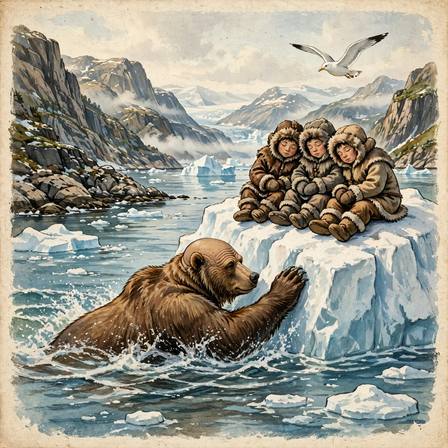
Greenlandic Inuit Tales — Part 2: Sitliarnat · The Kivigtok · Arnarsarsuak, the Kivigtok Woman
Disclosure: this performance is narrated by AI-generated voices.
Part Two of the Greenland shelf: Greenlandic Inuit tales, from Tales and Traditions of the Eskimo (Edinburgh and London: William Blackwood and Sons, 1875) by Dr Henry Rink (1819–1893) — the Danish geologist who spent sixteen winters and twenty-two summers in Greenland, collected these tales from Greenlandic tellers, and translated them from the Danish himself; the English edition was edited by Dr Robert Brown (1842–1895). Billed by collector and book, as the tales Rink gathered in Greenland; not a survey of all Greenlandic tradition, and no completeness is claimed. The tales were screened in the order they stand in Rink's book under this shelf's standing rule, and a great many were set aside — every one stands named, with its reason, in the shelf register.
Sitliarnat — three brothers, drifted away on an iceberg to an unknown shore, are taken in by an old couple whose lost provider comes home pale and weaponless; years later the old man turns into a bear and pushes their iceberg across the open sea, and the brothers keep their promise when the bald-headed bear comes to their shore. The Kivigtok — a young man who fled from mankind to a cave in the rocks is found by his father and brothers after two summers of searching, agrees to come home, and gives them the slip at the very last moment. Arnarsarsuak, the Kivigtok Woman — a young woman who fled her home returns years later, drawn by her own song, to the two orphans who had once shown her kindness, and raises a family in which bear cubs and children are nursed side by side.
Chapters:
0:35 Introduction
2:21 Sitliarnat
12:17 The Kivigtok
15:42 Arnarsarsuak, the Kivigtok Woman
Henry Rink, Tales and Traditions of the Eskimo (William Blackwood and Sons, 1875) — public domain.
Narrated by Scratch. Music: the episode's theme, "Istanbul Cello Nocturne" — heard at the introduction, as a short separator between the tales, and at the close; the tales themselves are read dry.
KacheliTV — world classics, read aloud.
