Part Two of our Togo shelf turns, as promised, to Jakob Spieth's parables and his chapter on the language of the birds — and completes its reading from the shelf's second gated source, A. B. Ellis's The Ewe-Speaking Peoples of the Slave Coast of West Africa (London, 1890).
Disclosure: this performance is narrated by AI-generated voices.
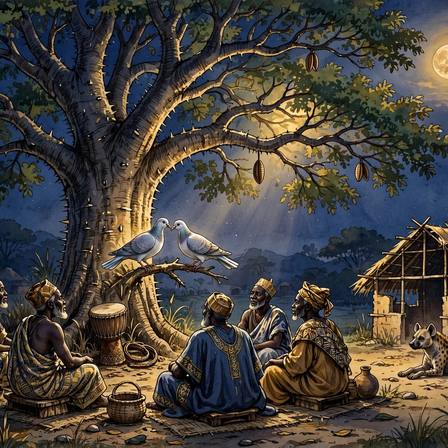
In The Three Orphans, three children who called their grandmother "Mother" learn the truth from their playmates, and set out to find their mother's grave in the stream — one to show the way, one to drink the stream dry, and one to know her bones again; Spieth's own printed answer to the parable's question is kept. In A Courtship in Bird Language, the doves akpakpa and voli plead their suits before the town elders in their own speech — one brought much, once; the other brings a little every day — and the elders judge what the birdsong means. In The Hyena and the Bush-Cat, two animals unknowingly build one house between them, each certain the work is doing itself, until a noise in the next room sends both running. And in Why Monkeys Live in Trees, the monkey who tied the sleeping bush-cat's tail to a tree learns why the ground is no longer safe for him.
Chapters:
0:00 Introduction
3:55 The Three Orphans
6:03 A Courtship in Bird Language
7:59 The Hyena and the Bush-Cat
12:26 Why Monkeys Live in Trees
Sources and selection: Spieth's parable chapter holds two parables; one is not read here — The Mender, the Hunter and the Thief — because its rescue turns on a shot fired at an eagle. Ellis's chapter holds four specimen tales; two are not read here — The Maiden Who Always Refused, and Why the Hare Runs Away — because each turns on depicted harm, which this channel does not read aloud. Our Togo reading therefore claims no more than the four pieces named above.
Sources: Jakob Spieth, Die Ewe-Stämme (Berlin, 1906) — parables and bird language, in a fresh in-house translation from the German; A. B. Ellis, The Ewe-Speaking Peoples of the Slave Coast of West Africa (London, 1890) — both public domain.
Narrated by Madame de Pamplemousse. Music: opening and closing theme, "Convergence at Dusk" — heard at the introduction and the close, and as a short separator between the tales; the tales themselves are read dry.
KacheliTV — world classics, read aloud.
