Six fables of the Ewe people, in a fresh English translation made for this reading from Jakob Spieth's Die Ewe-Stämme (Berlin, 1906), his great record of the Ewe of Togo — the opening of our Togo shelf.
Disclosure: this performance is narrated by AI-generated voices.
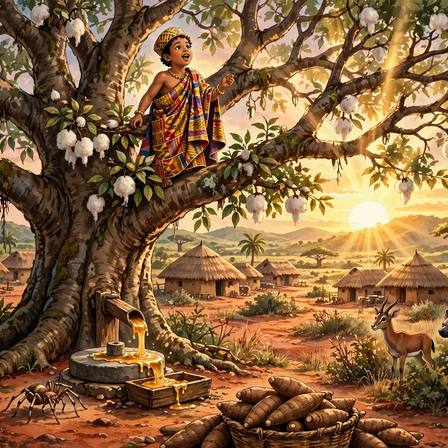
In Safudu Kwaku, a small boy no one believes in turns out to be the very one the silk-cotton tree has been waiting for, and his sweet voice founds a town. In The Spider and Her Friend, a self-grinding millstone grinds honey and palm wine until greed gets the last word. In The Seven Hunters, seven brothers go to war with Tomi, the giant of the wilderness — and the youngest saves them all with nothing but a footprint full of sand. In The Spider and the Chief, the Spider lends her gold away without a surety and learns the proverb the hard way. In God, the Antelope and the Hyena, God's own cook very nearly ends up in the pot instead of the antelope. And in The Yam That Set Up a King, a single yam, passed from farm to farm, grows so big it settles a whole people's argument — and leaves us the tale's closing lesson on the worth of a working tool. Spieth prints the ordeal honestly: in the first tale the innocent leaps seven times onto swords and needles, takes no harm, and heaven itself intervenes — the tale is told as he recorded it, uncut.
Chapters:
0:00 Introduction
2:34 Safudu Kwaku
5:26 The Spider and Her Friend
9:10 The Seven Hunters
13:05 The Spider and the Chief
15:12 God, the Antelope and the Hyena
18:25 The Yam That Set Up a King
Sources and selection: Spieth's Fabeln chapter holds eleven fables; five are not read here — Sehle, The Spider and the Leopard, The Woman and the Bird Aloe, The Spider and Yiyisa, and Death and the Spider — because each turns on depicted harm, which this channel does not read aloud. Two period racial terms in the last tale's dialogue have been rendered in neutral modern words; the facts and the sentences stand unchanged. Our Togo reading therefore opens with these six fables and claims no more than that: Part 2 will turn to Spieth's parables and his chapters on the language of birds.
Source: Jakob Spieth, Die Ewe-Stämme: Material zur Kunde des Ewe-Volkes in Deutsch-Togo (Berlin, 1906) — public domain; fresh in-house translation from the German.
Narrated by Scratch. Music: opening and closing theme, "The Longest Night by the River 2" — heard at the introduction and the close only; the tales themselves are read dry.
KacheliTV — world classics, read aloud.
Ewe folk tales · Togo fairy tales · Jakob Spieth · African fables · Spider trickster tales · West African folk tales · world folk tales · free audiobook
