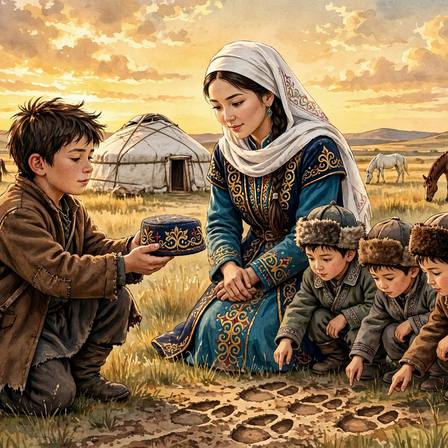
Part Two returns to the folk tales of the Kasak people — the Kazakhs — as Wilhelm Radloff collected and translated them in the third part of his "Specimens of the Folk Literature of the Turkic Tribes of Southern Siberia," published by the Imperial Academy of Sciences at Saint Petersburg in 1870. Radloff's book names this part for the "Kirghiz dialects," and in his own preface he explains why: the people of the steppe from the Altai to the Ural call themselves Kasak, and "Kirghiz" is the name the Russians and Europeans wrongly gave them. The tales are billed exactly as he presents them, and Radloff's German rendering is here turned into English. No more than that is claimed.
Disclosure: this performance is narrated by AI-generated voices.
Part Two tells two tales whole. In "The Child Who Was Apprenticed to the Mullah," an orphan schoolboy who has nothing with which to feast his eight and thirty schoolfellows begs a lapful of bread, meets a beautiful girl, and takes her little cap — and the Khan takes the cap and orders him, on the usual spoken threat, to find its owner. His schoolfellows stand surety for him with their own heads pledged in words, and he finds the girl and brings her back in time to free them all. In "The Three Sons," three brothers who have lost the three hundred roubles their father left them go to a prince for judgment, and on the road — and at his table — they show a gift for seeing what is hidden, until the prince tests them with a tale of his own: whose mind, among a bridegroom, a schoolfellow and forty robbers, was pure?
Told exactly as printed, with nothing softened and nothing added: every threat in both tales is spoken and never carried out; no blow is struck and no one is harmed on the page; the one death, the Khan's, is announced the morning after, off the page and unexplained, in the tale's own formula.
Of the book's prose tale sections — two hero tales and eleven numbered tales, one of them a set of riddles — ten have now been read in full on this shelf. Three are told in Parts One and Two. One more was read in full for this part and is excluded by name under this library's standing rule that tales built on enacted violence are set aside, not retold: "Dudar Kyz," in which a wolf-bridegroom devours a camel and a maid, a forged letter orders a mother and her child burned, and a horse is killed on the page. Six were excluded by name at Part One. Two tales and the riddle set stand unscreened for later parts. No completeness is claimed.
Chapters:
0:00 Introduction
2:25 The Child Who Was Apprenticed to the Mullah
13:25 The Three Sons
Source: W. Radloff, Proben der Volkslitteratur der türkischen Stämme Süd-Sibiriens, Part III (Saint Petersburg, 1870) — public domain. Fresh English translation for this reading.
Narrated by Mira. Music: the theme "Convergence at Dusk" — heard at the introduction, between the two tales, and at the close only; the tales themselves are read dry.
KacheliTV — world classics, read aloud.
