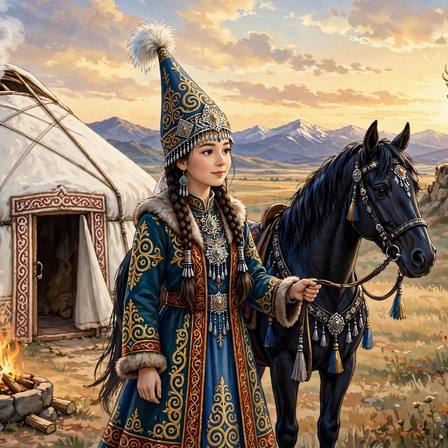
A new shelf opens. These are folk tales of the Kasak people — the Kazakhs — as Wilhelm Radloff collected and translated them in the third part of his “Specimens of the Folk Literature of the Turkic Tribes of Southern Siberia,” published by the Imperial Academy of Sciences at Saint Petersburg in 1870. Radloff’s book names this part for the “Kirghiz dialects,” and in his own preface he explains why: the people of the steppe from the Altai to the Ural call themselves Kasak, and “Kirghiz” is the name the Russians and Europeans wrongly gave them. The tales are billed exactly as he presents them, and Radloff’s German rendering is here turned into English. No more than that is claimed.
Disclosure: this performance is narrated by AI-generated voices.
Part One tells one tale whole: “The Khan’s Daughter.” A khan gives his vizier three days to report what two wild geese said as they flew over, on pain of losing his head — and it is the Khan’s daughter who knows, for she has understood the geese: a bad husband, a good wife can nourish. To test her word, the Khan marries her to the worst man he can find, a poor scab-head. What follows is her doing: the well whose water runs mixed with gold, the black-blue horse bought for a clothful of tillas, the stag with a head of gold and hindquarters of silver, the wish of three days and nights when no fire may burn in any house but hers, and a meal on the hunt that wakes her father’s memory.
Told exactly as printed, with nothing softened and nothing added: the Khan’s threats are spoken and never carried out; the one knife drawn in the tale is put by, and the stag is given living to the Khan; the old Khan’s death at the close comes after the reconciliation, off the page, in the tale’s own formula.
Of the book’s prose tale sections — two hero tales and eleven numbered tales, one of them a set of riddles — eight were read in full at this shelf’s gate. One is told here. One more passed its reading whole and is held for Part Two: “The Child Who Was Apprenticed to the Mullah.” Six are excluded by name under this library’s standing rule that tales built on enacted violence are set aside, not retold: “Kan Schentäi,” “Erkäm Aidar,” “Eshigäldi,” “How the Good and the Evil Were Companions,” “The Scab-Head Who Bought the Dream,” and “The Cunning of the Fox.” Four tales and the riddle set stand unscreened for later parts. No completeness is claimed.
Chapters:
0:00 Introduction
2:22 The Khan’s Daughter
Source: W. Radloff, Proben der Volkslitteratur der türkischen Stämme Süd-Sibiriens, Part III (Saint Petersburg, 1870) — public domain. Fresh English translation for this reading.
Narrated by Scratch. Music: opening and closing theme, “The Spring Remembers 2” — heard at the introduction and the close only; the tale itself is read dry.
KacheliTV — world classics, read aloud.
