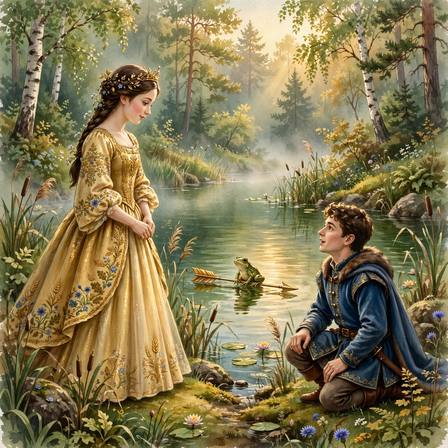
A new shelf opens with one tale told whole: "The Frog Princess," the first tale in "Polish Fairy Tales" — tales of the peasantry of Poland's eastern provinces as collected by A. J. Gliński and printed at Wilna in 1862, in Maude Ashurst Biggs's English translation (John Lane, 1920). In her preface Biggs tells the reader plainly that she shortened Gliński's tellings for English readers, keeping their wonder while trimming the repetition of the originals; her shortened English text is what is read here, faithfully as printed, songs and all.
Disclosure: this performance is narrated by AI-generated voices.
An old king will leave his crown to whichever son chooses the best wife, so his three sons shoot arrows from a high tower to find their brides. Two arrows find fine ladies. The youngest prince's arrow falls into a lake, among the reeds — where a little frog is sitting on it, and talks. She weaves a carpet no loom could match, bakes a cake no kitchen could better, and comes to the king's banquet in a beauty no one expects. But when her frog-skin is burned against her wishes, she flies away as a duck, and the prince must follow balls of thread and hold fast through every shape she takes to win her back.
A. J. Gliński, Polish Fairy Tales, translated by Maude Ashurst Biggs (John Lane, 1920) — public domain.
Narrated by Mira. Music: instrumental bed, "Wind Swept Flight."
KacheliTV — world classics, read aloud.
Polish folk tales · Polish fairy tales · Polish folk tales audiobook · Polish folklore · A. J. Gliński · Slavic folk tales · world folk tales · free audiobook
