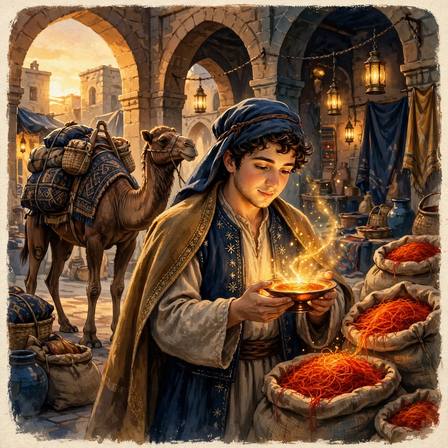
A new shelf opens with tales of Damascus, collected and translated by Johannes Østrup in his "Contes de Damas," published at Leyden by E. J. Brill in 1897. Østrup heard the tales in Damascus itself, from a miller named Ahmed, a storyteller of remarkable memory. These are tales of Damascus, billed by their city and their collector — not the whole of Syria's tradition. The English you hear is a fresh translation, made for this shelf, of Østrup's French.
Disclosure: this performance is narrated by AI-generated voices.
In "The Merchant's Son and the Indian Merchant," a boy is raised in an underground room and grows to fifteen without knowing that anyone else exists in the world. Sent out at last with forty loads of saffron and his father's strange command — sell to one man only, and take the money all in one kind of coin — he crosses Beirut, Cairo, Constantinople, Russia and Persia without a buyer, until an Indian merchant in India pays him more than he asked, and gives him a parting gift: a dish and a bowl, to be kept with care. What that dish can do, and what pride costs the man who once boasted that he had more gold than God, is the heart of the tale.
"The Dying Man and His Son" is told in a breath. A poor old man falls ill; the doctor feels his pulse, names his one chance of life, and takes his fee. By morning the old man is dead — and at the grave, his son answers the friends who come to comfort him with a piece of logic they did not expect.
Told as the tales tell them, with these passage notes declared: in the first tale, the Indian merchant's boast, "I possess more gold than God," is his own spoken pride, punished by ruin within the story and answered by his repentance; his house burns after a lamp falls, in one sentence, with no one harmed. In the second tale, the father dies of illness in his bed, and the doctor's remedy and the son's graveside answer turn on breaking wind — the tale's earthy folk humour, carried as written. Of the book's ten tales, four are not told on this shelf because their plots turn on depicted violence — "The Jew and the Two Sons of the Merchant," "The Youngest Son of the Merchant," "The Three Princes and the Golden Bird," and "The Cadi and the Mufti" — and four more are held for a ruling by name: "The Demon's Daughter," "The Treacherous Friends," "The Peasant, the Ox and the Ass," and "The Cunning Wife."
Chapters
1:16 The Merchant's Son and the Indian Merchant
10:56 The Dying Man and His Son
Johannes Østrup, Contes de Damas (Leyde: E. J. Brill, 1897) — public domain.
Narrated by Violetta. Music: instrumental bed, "Tampa Across the Water."
KacheliTV — world classics, read aloud.
Syrian folk tales · Damascus folk tales · Syrian folk tales audiobook · Arabic folk tales · Johannes Østrup · Middle Eastern folk tales · world folk tales · free audiobook
