Four more tales of the Kongo people — the Bakongo — of the Lower Congo, written down by the teachers and boys of the Wathen Mission School at Wathen, that is Ngombe Lutete in what is today the Democratic Republic of the Congo, and around San Salvador, and published by the Reverend John H. Weeks in his "Congo Life and Folklore" in London in 1911, as stories told round the evening fires. With this part, our Bakongo shelf is complete: sixteen of Weeks's thirty-three stories, told across three parts.
Disclosure: this performance is narrated by AI-generated voices.
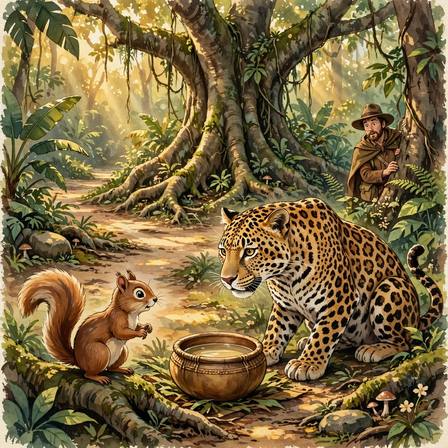
A squirrel, spared at the traps, repays the kindness twice over — first answering the Leopard's skull-mug boast with a bluff of his own, then scattering the Imps who demand half of Tunga's wife, with a dancing calabash and a swarm of bees. A small boy saves his mother from the pit-trap bargain by turning the bargain on the Imp who made it: the Imp who jumps into the trap becomes, by his own terms, a male animal in it. A gazelle robs the Leopard's plum-tree with a bottomless bag, a palm-rat knocks his head swollen learning the way up, and a frog who is set to watch a hole has pepper blown into his eyes — which is why the frog's eyes bulge to this day. And a son who hides himself as a peanut kernel is swallowed, and swallowed again, until his father opens the fish-trap and finds him, layer inside layer, unharmed.
Declared passage notes, exactly as the tales tell them: in "How the Squirrel Repaid a Kindness," the Leopard's eaten-nine-men boast and the Imp's demand for "half of the woman" are threats and bluffs, answered and refused — nobody is eaten, divided or killed, and the bees sting the Imps away. In "How a Child Saved His Mother's Life," the trapped animals are taken home for meat morning after morning, told as a tally, not depicted. In "The Leopard Is Badly Tricked by the Gazelle, Rat and Frog," the Palm-rat's head knocks swollen against the plum-tree — the tale's own explanation of his bump — the thieves caught by the Leopard are "caught and punished," the tales do not say how, and the pepper blown into the Frog's eyes is washed out in the stream. In "The Son Who Tried to Outwit His Father," the swallowing chain is told in clauses, and the son steps out unharmed.
John H. Weeks (1861–1924), "Congo Life and Folklore" (London: The Religious Tract Society, 1911), Part II, stories XV, XIX, XXXI and XXXIII. These are tales of the Kongo people of the Lower Congo, billed by their people and their collector — not the whole of DR Congo. Seventeen of the thirty-three stories are excluded by name in the shelf's register and are not told in any part.
Narrated by Madame de Pamplemousse. Music: opening and closing theme, "Desert Cello Rhapsody".
Chapters:
01:57 How the Squirrel Repaid a Kindness
07:51 How a Child Saved His Mother's Life
12:10 The Leopard Is Badly Tricked by the Gazelle, Rat and Frog
19:59 The Son Who Tried to Outwit His Father
Bakongo folk tales · Kongo folk tales · DR Congo folk tales · African folk tales · John H. Weeks · world folk tales · free audiobook
