Six more tales of the Kongo people — the Bakongo — of the Lower Congo, written down by the teachers and boys of the Wathen Mission School at Wathen, that is Ngombe Lutete in what is today the Democratic Republic of the Congo, and around San Salvador, and published by the Reverend John H. Weeks in his "Congo Life and Folklore" in London in 1911, as stories told round the evening fires.
Disclosure: this performance is narrated by AI-generated voices.
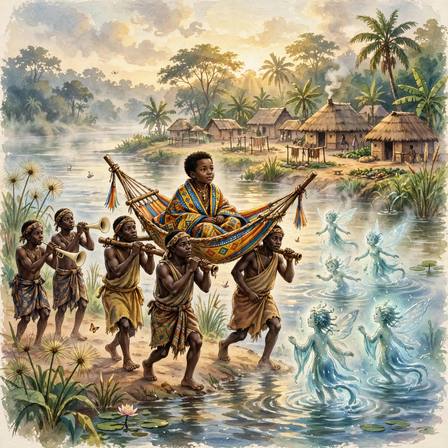
A small-ant wins a contest of strength by patience, working a piece of skin loose where the fierce driver-ant failed. The fowls quarrel over who shall shut the door, and hold their owner up to his own words when a buffalo is left to rot by the roadside. Four companions agree never to thwart one another, and wait — for palm-nuts, for burnt bush, for new canes, and for a dog's nose that will never dry. A gazelle, sent on a journey to buy drums, opens the leopard's sack and turns the leopard's own trick back on him. A crow who claims every kill cries "It is mine" once too often, over the body of the chief huntsman. And a boy named Yakob, killed by his father for freeing the trade birds, is found by the water-fairies, restored to life and raised by them, and returns in state to forgive his father.
Declared passage notes, exactly as the tales tell them: in "Why the Small-Ant Was the Winner," the driver-ant is picked off the man's hand and dropped dead, in one clause. In "Why the Fowls Never Shut Their Doors," a buffalo is shot, killed and cut up inside the cock's story, in clauses, and the meat is left to rot. In "Why the Dog and the Palm-Rat Hate Each Other," the dog chases the palm-rat to kill him — the intent is told, no blow lands. In "The Gazelle Outwits the Leopard," the leopard means to sell the gazelle's children for drums; the gazelle exchanges his own children back unharmed, and the leopard's children are the ones carried home in the sack. In "How the Crow Cheated the Dove," the dove accidentally shoots the chief huntsman dead, and the elders lay the burial and all the funeral expenses on the crow. "The Water-Fairies Save a Child" is told whole, as Weeks printed it: the father's killing of his son, the water-fairies' restoration, and the son's return and forgiveness all stand as told.
John H. Weeks (1861–1924), "Congo Life and Folklore" (London: The Religious Tract Society, 1911), Part II, stories II, IV, V, X, XII and XIV. These are tales of the Kongo people of the Lower Congo, billed by their people and their collector — not the whole of DR Congo.
Narrated by Bruno. Music: opening and closing theme, "Calm After the Current 2".
Chapters:
01:58 Why the Small-Ant Was the Winner
03:14 Why the Fowls Never Shut Their Doors
06:28 Why the Dog and the Palm-Rat Hate Each Other
08:44 The Gazelle Outwits the Leopard
11:31 How the Crow Cheated the Dove
13:10 The Water-Fairies Save a Child
Bakongo folk tales · Kongo folk tales · DR Congo folk tales · African folk tales · John H. Weeks · world folk tales · free audiobook
