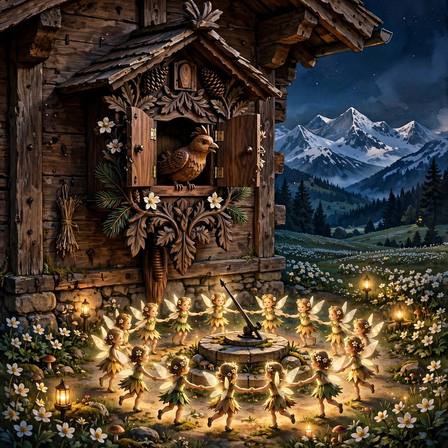
Two tales from the Swiss mountains, from William Elliot Griffis's "Swiss Fairy Tales," published at New York in 1920. Griffis (1843–1928) dedicated the book to the radiant memories of his Swiss maternal ancestry, from whose lips he first heard stories of Switzerland, the land of the edelweiss.
Disclosure: this performance is narrated by AI-generated voices.
In "The Fairy in the Cuckoo Clock," old Soft Pudding, a kind-hearted and absent-minded man, takes a lantern into his garden on an autumn night to read the time on his new sundial, and breaks up the fairies' dance. Kindness is answered with kindness: the Queen of the Fairies comes to him in a dream and shows him a clock that needs no sun, with a wooden cuckoo to call out the hours — the invention that made Switzerland a land of clocks, watches and musical boxes.
In "The Ass That Saw the Angel," Gruntli of the Grisons, a rich and proud "man of science" who believes only in what he can see, taste, smell, hear or handle, rides his faithful white ass Gulick to view the ruin of Plurs, a town wiped out by a landslide. On the narrow path the ass stops, and stops again, before a shining angel holding a drawn sword — an angel his master cannot see. What Gruntli learns on that path changes his life. Griffis founded this tale on the story of Balaam and his ass (Numbers 22). It is told here under the owner's ruling of 19 October 2026, which admitted this one tale by name as an exception to the standing park on sacred texts; no other sacred-text material stands in this shelf.
Declared passage notes, exactly as the tales tell them. In the first tale, the owl's speech describes the cuckoo's ways in nature terms — its eggs laid in other birds' nests, the rightful eggs thrown out and nestlings lost — and the fairies, the tale says, would be turned to stone if the sun's rays struck them, as mortals on high mountains might be sunstruck and die; nothing of the kind is shown. In the second tale, the landslide at Plurs is told of as a calamity already past — the town found buried under earth, rock and snow; no death is shown, and the living Gruntli finds there are the survivors he afterwards helps. Gruntli, in his anger, beats the ass and drives in his spurs until, in the tale's words, little drops of blood drop on the ground — the cruelty the story itself rebukes: he washes the stains away, throws his spurs away, and spends his wealth on relief and better houses for his tenants. His one cry, "I just wish I had a sword to kill you," is spoken in rage and never acted on.
Chapters:
2:00 The Fairy in the Cuckoo Clock
17:46 The Ass That Saw the Angel
William Elliot Griffis, "Swiss Fairy Tales" (New York: Thomas Y. Crowell Company, 1920), Chapters IX and XXIV. Two tales of the book's twenty-two, billed by their book and their teller — not the whole of Switzerland. Of the tales not in this part, two are excluded by name and the rest stand unscreened on the bench (register in the shelf canon).
Narrated by Madame de Pamplemousse. Music: opening and closing theme, "Before the Pines End 2."
Switzerland folk tales · Swiss fairy tales · Alpine folklore · William Elliot Griffis · world folk tales · free audiobook
