Six tales of the Ekoi and their neighbours, the peoples of the Cross River country in the Ossidinge district of Kamerun, recorded by Alfred Mansfeld between 1904 and 1907 and published in his "Urwald-Dokumente" in Berlin in 1908 — fresh English translations made for this episode from Mansfeld's German.
Disclosure: this performance is narrated by AI-generated voices.
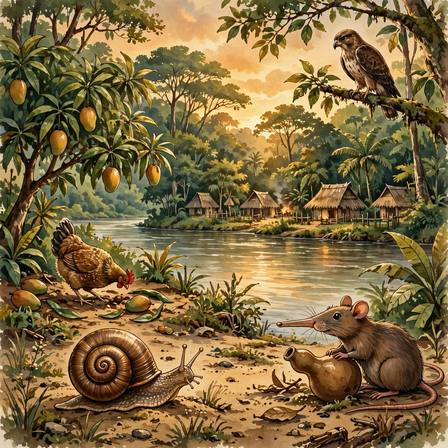
God teaches a waiting assembly what dying is by letting them fall asleep. Kukuoluka, keeper of all the mango trees, knocks out teeth with his stones, and the chicken searches the earth for its buried teeth to this day. A rat in a juju dress steals the land crab's cocoyams three times, and pays with a nose that will not come free. A hawk hides on a buffalo's horn, and one knowing chicken gives him away. A widow follows her dead husband to the great tree on the Oban road, a shot scatters the procession of the dead, and she is found living at home. And the slowest bearer
Declared passage notes, exactly as the tales tell them: in "The Story of the Man Kukuoluka," the stones Kukuoluka throws knock out teeth — the chicken's teeth, and one tooth each from the wild cat and four other animals. In "Why the Rat Has a Long Snout," the rat, held fast by the nose in one passage, is beaten soundly with a stick while she pulls to free herself; her nose stretches long — the etiological punchline, and she lives. In "Why the Hawk Always Catches Chickens," the hawk in the final clause seizes the chicken that betrayed him and carries it up into the air. In "Why Shots Are Fired at Funeral Feasts," a rifle is fired at the procession of the dead; no living person is harmed, and the widow is found alive. In "The Snail," the snails are told as the people's slaves and load-bearers in the old days — the tale's own premise, disclosed as told and rendered in neutral modern terms; the snail is banished to the bush, nothing worse.
Alfred Mansfeld (1870–1932), "Urwald-Dokumente" (Berlin: Dietrich Reimer (Ernst Vohsen), 1908), appendix "Sagen und Märchen," pp. 229–237. These are tales from Mansfeld's appendix, billed by their people and their collector — not the whole of Cameroon.
Narrated by Scratch. Music: instrumental bed, "Santa Fe Springs 2."
Chapters:
01:32 Sleep and Death
02:17 The Story of the Man Kukuoluka
03:40 Why the Rat Has a Long Snout
04:57 Why the Hawk Always Catches Chickens
05:47 Why Shots Are Fired at Funeral Feasts
06:50 The Snail (Nko), or: How People Came to Carry Their Own Loads
Cameroon folk tales · Ekoi folk tales · Cross River folklore · African folk tales · Alfred Mansfeld · world folk tales · free audiobook
