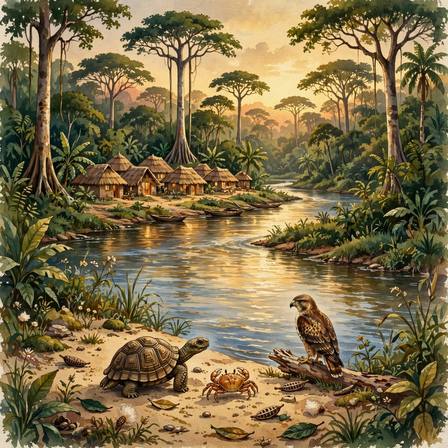
Eleven tales of the Ekoi and their neighbours, the peoples of the Cross River country in the Ossidinge district of Kamerun, recorded by Alfred Mansfeld between 1904 and 1907 and published in his "Urwald-Dokumente" in Berlin in 1908 — fresh English translations made for this episode from Mansfeld's German.
Disclosure: this performance is narrated by AI-generated voices.
God's three children go hunting, and the unloved Moon comes back to order the whole of life. A land crab answers a mean share of the hunt with pepper and stolen water. A fly's careless wish runs through snake, rat and monkey until the day itself goes dark. A cast-out Body is raised up by a stranger's cowrie and a fruit from heaven. A boy follows a fallen nut down to the dead, and a goat pays for the horn he carried off. A tortoise visits the hawk in a banana-leaf parcel. A monkey teaches a leopard to clap his paws in thanks. One quill frightens an elephant. God settles the lending of a razor. A fly waits at the cow's eye for the feast that never comes again. And two wives are answered by their harvests.
Declared passage notes, exactly as the tales tell them: in "Sun, Moon and Darkness," rifles appear in the premise and one bird is shot; the Moon, sent to the dead, is pounded like yam and re-formed by his friend Egbe — a mythic transformation, not an injury. In "Why the Land Crab Lives under the Earth," the opening premise is a battue hunt whose tally is told, not depicted. In "Small Causes, Great Effects," the chain ends with a guineafowl's egg crushed — the one death, of the unhatched chick, in a clause. In "Why the He-Goat Stinks," one clause tells of blood from the goat's buried foot, mistaken for a root; the dead smear him with corpse-fat as his punishment. In "Why the Tortoise's Shell Is Made of Small Pieces," the hawk throws the tortoise down — the etiological punchline, with no blood and no death. In "The Porcupine," the elephant keeps the porcupine's cloth and gives no slave for it — a slave-trade premise, disclosed as told — and rushes at the porcupine to kill him; no blow lands, and the porcupine escapes into his hole. "Offerings to the Dead Bring Blessing" is told in the tales' own belief world, in which a small offering of the harvest to the dead is answered by the crop.
Alfred Mansfeld (1870–1932), "Urwald-Dokumente" (Berlin: Dietrich Reimer (Ernst Vohsen), 1908), appendix "Sagen und Märchen," pp. 229–237. These are tales from Mansfeld's appendix, billed by their people and their collector — not the whole of Cameroon.
Narrated by Benedetto. Music: instrumental bed, "Istanbul Cello Nocturne."
Chapters:
01:51 Sun, Moon and Darkness
05:38 Why the Land Crab Lives under the Earth
07:39 Small Causes, Great Effects
09:36 The Limbs
11:08 Why the He-Goat Stinks
12:17 Why the Tortoise's Shell Is Made of Small Pieces
13:09 The Monkey
13:51 The Porcupine
14:41 Why Children Walk Only after a Year, but Goats a Day after Birth
15:24 Why the Flies Always Fly around the Cattle's Eyes
16:01 Offerings to the Dead Bring Blessing
Cameroon folk tales · Ekoi folk tales · Cross River folklore · African folk tales · Alfred Mansfeld · world folk tales · free audiobook
