Folk Tales of the United Kingdom continues with five more tales of England and Scotland as Joseph Jacobs collected them in his More English Fairy Tales (London, 1894). They are read here complete, exactly as written.
Disclosure: this performance is narrated by AI-generated voices.
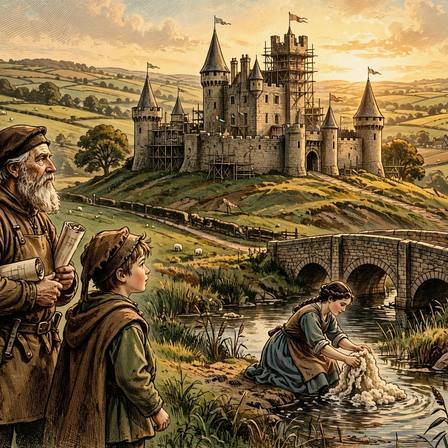
In Gobborn Seer, Jack is sent to sell a sheepskin and to bring back the skin and its price together, and the witty girl who washes at the bridge solves it for him by washing the wool out of the skin; she marries him, and when Gobborn Seer has built the king a castle that is to outshine all others, it is her wit again — a message of "Crooked and Straight" — that brings father and son safe home. Lawkamercyme is a tale in verse: an old woman falls asleep on the king's highway on market day, a pedlar cuts her petticoats round about, and waking she cannot believe she is herself, until she goes home to ask her little dog. In Coat o' Clay, a Lindsey fool asks the wise woman to make him wise, and she tells him he will know more than she when he gets a coat o' clay; he tries the drain's mud, the highroad's dust, and the inn's good liquor in turn, and is a bigger fool for each, before she tells him where the only coat o' clay is to be had. In Scrapefoot, the fox Scrapefoot creeps into the three Bears' castle in the wood, sits in their three chairs, drinks from their three saucers, and sleeps in their three beds. And in A Son of Adam, a labourer who curses Adam for the digging he must do is set before a table of good things with one covered dish in the middle that he must not touch till his master comes back.
A note on the tales as written. Three moments of the old tales' colour are worth naming plainly. In Gobborn Seer, the king means to take the builders' lives on the morrow lest they carry their art to another king — an intention the housekeeper reports and the tale averts by wit; the king's son, sent on the errand, is shut in a chest with holes bored that he might breathe, and is let free unharmed when Gobborn and Jack are safe home. In Coat o' Clay, the landlord who has let the fool drink on credit kicks him out of the inn door into the road — one farce blow, and the fool gets up and walks home; the tale's sting is the wise woman's closing truth, that the only coat o' clay is the one a man's folk put him in at the end. In Scrapefoot, the Bears talk of hanging and of drowning their intruder and settle for throwing him out of the window; he shakes each leg in turn, finds no bone broken, and gallops home. No word has been altered in any of the five: no period slur occurs in these tales, and nothing in the telling called for one to be softened or set aside.
Chapters
0:00 Opening Theme
1:03 Gobborn Seer
7:41 Lawkamercyme
8:47 Coat o' Clay
20:30 Scrapefoot
26:05 A Son of Adam
From More English Fairy Tales (1894), collected by Joseph Jacobs — public domain. Tales of England and Scotland as Jacobs collected them; no Irish tales appear on this shelf. Narrated by Mira. Music: opening and closing theme, "Nocturne in 124" — heard at the introduction and the close only; the tales themselves are read dry.
KacheliTV — world classics, read aloud.
British folk tales · English fairy tales · British folk tales audiobook · English folklore · Joseph Jacobs · English fairy tales audiobook · world folk tales · free audiobook
