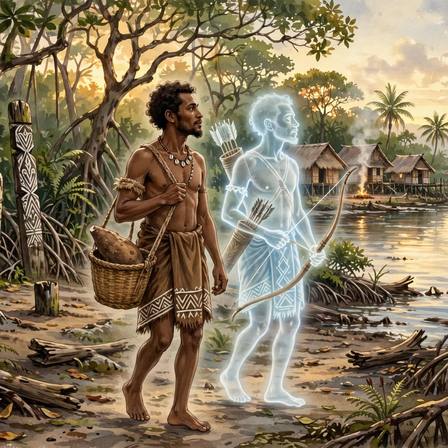
Folk Tales of Papua New Guinea continues with nine more tales of the Kiwai Papuans of the Fly River, in what is now the Western Province of Papua New Guinea. They were collected by Gunnar Landtman, who lived with the Kiwai people from 1910 to 1912 and recorded the tales from named Kiwai narrators, and published in his The Folk-Tales of the Kiwai Papuans (Helsingfors, 1917). They are read here in Landtman's own English text, lightly normalized, by Mira.
Disclosure: this performance is narrated by AI-generated voices.
In Ánai Under the Burial Ground, Kogéa's spirit breaks open his grave, draws his living brother Ánai down into the place of the dead for four days, and teaches him yam-planting; of the spirit food he carries home, one danaki yam alone stays in his basket. In Dódo Carried Off by a Spirit, told by Bíri of Ipisía, a spirit under a house seizes a man from the verandah, leaves him dead on the road, killed by the dead man's cold, and he revives only beside a big fire. In The Two Girls and the Spirit-Boys, told by Amúra of Mawáta, two girls follow the ídera spirit-boys into the bush; one steps through the hole the spirits open and never returns, and her parents wail. In The Spirit Who Helped a Man Fish, told by Námai of Mawáta, Góboi — who had killed people in his life, in one clause of Landtman's — sets the tusked spirit in his canoe to pole the stern; it takes two small fish only, and Góboi wails for his unrepayable friend. In The Spirit Who Came to Look for a Friend, told by Námai of Mawáta, two boys joke in fun about killing each other when dead; when Sáe dies, his armed spirit keeps it and hunts Adági, who flees bleeding through the thorns — no shot is fired, and Sáe gives up at the beach. In Visited by His Brother's Spirit, told by Gibüma of Mawáta, Áua's spirit knocks at the fence and tells his brother Míruu, "I stop good place — you no cry for me too much," leaving a belt behind; since then his clansmen mourn two or three weeks only. In Kítuáre and the Spirit of His Wife, told by Tom of Mawáta, Kítuáre's wife dies in childbirth while he hunts (one clause); her spirit lights his fire in a bush hut, rides standing on his knees in the canoe, and tears free at the village, leaving her wrist's skin in his hand — her body's wrist is whole. In The Woman Who Heard a Spirit Calling His Tame Pig, told by Amúra of Mawáta, Wabíra hears an óboro at sundown calling his pig Bírari and his boy Wärai; her kin name pigs Bírari and a boy Wärai. And in The Man Who Heard a Spirit Calling His Dogs, told by Amúra of Mawáta, Néteru, the narrator's grandfather, hears an óboro call its dogs — "Nünu, Téperi, Gáido!" — and gives his own dogs the spirit's names.
Chapters
0:49 Ánai Under the Burial Ground
4:36 Dódo Carried Off by a Spirit
6:26 The Two Girls and the Spirit-Boys
8:27 The Spirit Who Helped a Man Fish
12:21 The Spirit Who Came to Look for a Friend
15:34 Visited by His Brother's Spirit
16:59 Kítuáre and the Spirit of His Wife
19:46 The Woman Who Heard a Spirit Calling His Tame Pig
20:55 The Man Who Heard a Spirit Calling His Dogs
From The Folk-Tales of the Kiwai Papuans (1917) by Gunnar Landtman — public domain. Music: gentle instrumental bed under the narration.
KacheliTV — world classics, read aloud.
Papua New Guinea folk tales · Papua New Guinea folk tales audiobook · Papuan folk tales · Kiwai tales · Gunnar Landtman · Oceanic folk tales · world folk tales · free audiobook
