Folk Tales of Papua New Guinea continues with six more tales of the Kiwai Papuans of the Fly River, in what is now the Western Province of Papua New Guinea. They were collected by Gunnar Landtman, who lived with the Kiwai people from 1910 to 1912 and recorded the tales from named Kiwai narrators, and published in his The Folk-Tales of the Kiwai Papuans (Helsingfors, 1917). They are read here in Landtman's own English text, lightly normalized.
Disclosure: this performance is narrated by AI-generated voices.
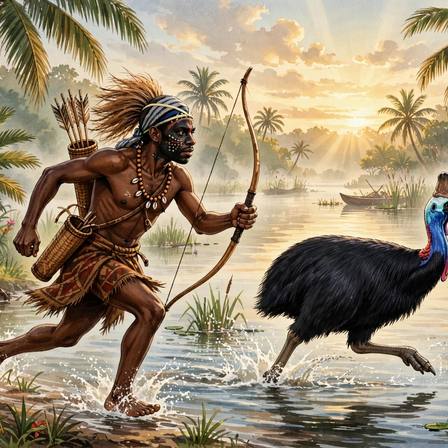
In Sabáke's Farewell to Old Mawáta, told by Amúra of Mawáta, Gaméa sails back to the old village to fetch his brother Sabáke, who cannot bear to leave it: Sabáke smears himself with mud in token of his sorrow, wails over the good sand of Old Mawáta, and sails weeping to the new village — bringing with him the taro, bananas, and garden plants that Mawáta lives by; a second telling, by Íku of Mawáta, gives the same farewell to Séga. In Páspae Who Was Born Under the Ground, told by Gaméa of Mawáta, a boy born beneath the earth at Írue, hidden there from the crocodiles, comes up into the sunlight, learns fire and house-building from his parents in dreams, and is taught "the fashion belong woman and man" by Múrke — a passage Landtman himself prints in abbreviated form, carried here exactly as printed; hunters still call Páspae's name before the hunt. In Wíobári and the Cassowary, told by Námai of Mawáta in its main version only, a boy conceived when his mother smells a banana chases the cassowary sent from Adíri the length of the coast, shooting and always missing, follows it into the land of the spirits, chooses his two wives there in one blunt clause of his own speech, and rides home on the bamboo that stretches across the water to Máo, ancestor of the Máo people. In Ásái in Adíri, the Land of the Dead, told by Gaméa of Mawáta, who had it from his father, Ásái dies and is welcomed among the spirits — but when Sído bids him take the girl given him, he will not look at her, and for that refusal Sído kicks him back into the world of the living. In Amára in Adíri, told by Gaméa of Mawáta, a dead woman passes the clashing posts into Adíri, where her husband Báua keeps her one day only — she must not eat the food of the dead — and sends her back at sunset charged to guard the burying ground well. And in Ásái Swims Home, told by Sáibu of Mawáta, Hamána, fishing before dawn, sees a shape swimming, takes it for a fish, and casts his spear — and misses; the spirit slips back into its body, and Ásái wakes to tell the road of the dead.
Chapters
0:32 Sabáke's Farewell to Old Mawáta
3:35 Páspae Who Was Born Under the Ground
7:08 Wíobári and the Cassowary
15:35 Ásái in Adíri, the Land of the Dead
18:29 Amára in Adíri
22:22 Ásái Swims Home
From The Folk-Tales of the Kiwai Papuans (1917) by Gunnar Landtman — public domain. Music: gentle instrumental bed under the narration.
KacheliTV — world classics, read aloud.
Papua New Guinea folk tales · Papua New Guinea folk tales audiobook · Papuan folk tales · Kiwai tales · Gunnar Landtman · Oceanic folk tales · world folk tales · free audiobook
