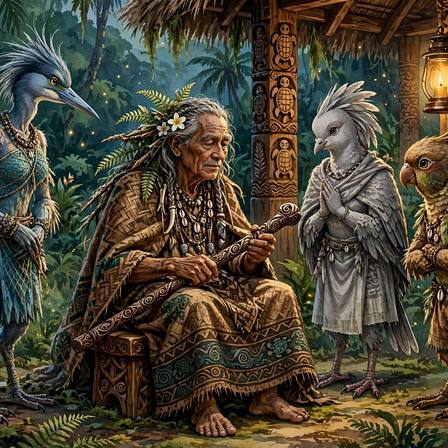
Folk Tales of Micronesia opens with two tales from the Caroline Islands, set down in English by F. W. Christian in The Caroline Islands (1899) — the first told on Pohnpei, the second told on Yap. Pohnpei and Yap are two of the four states of the Federated States of Micronesia, and these are their stories as Christian heard them in the islands in the 1890s, read here in his own words.
Disclosure: this performance is narrated by AI-generated voices.
In The Story of the Naming of Birds, Laponga, the terrible High Priest and wizard of Metalanim on Pohnpei, discovers that his forest children — the bird-people who once spoke and walked like men — have stolen the secret of his kava. His curse takes their human speech and shape forever, and the tale tells why the heron still croaks for a croak's worth of reason, why the dove wails for her lost children, why the little brown parrakeet falls giddy to the ground when a stone is thrown, and how the curse followed Laponga himself in the end. In The Flood Legend of Yap, told to Christian by Toluk, the old chief of Omin, the fairy's daughter who wed the mortal Maralok draws down her mother Loth's wrath, and the sea rises over nearly all Yap; the prudent couple who heed the warning survive on the hilltop, and Yalafath, the good spirit of the air, sends down the banana, the taro, and the yam, and calls the eight Kan into being — the generations of the children of Yap.
The Flood Legend of Yap is an old sacred myth of the island, carried here as it was told and set down — its deaths are the universal deluge motif, told in single clauses, as the register in our shelf canon records. One item in the same book stands excluded by name in that register and is not read here or anywhere on this shelf: the traditional account of the fall of Nan Madol, a conquest narrative of invasion and slaughter.
Chapters
0:15 The Story of the Naming of Birds
6:31 The Flood Legend of Yap
From The Caroline Islands: Travel in the Sea of the Little Lands (1899) by F. W. Christian — public domain. Music: gentle instrumental bed under the narration.
KacheliTV — world classics, read aloud.
