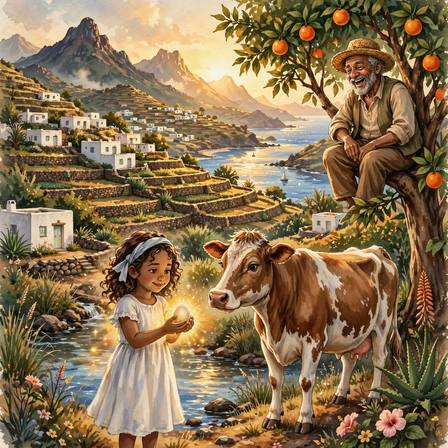
Folk Tales of Cabo Verde — Part 4. Three tales from Folk-Lore from the Cape Verde Islands (1923) by Elsie Clews Parsons, collected from Cape Verdean storytellers living in New England in 1916–17 and printed in 1923 — read aloud exactly as Parsons printed them, in her English text. Sixteen minutes of story.
Disclosure: this performance is narrated by AI-generated voices.
GOOD MARIA AND BAD MARIA. Two girls, both named Maria. Good Maria's cow does all her work for her, until her stepmother feigns sickness and asks for the cow's liver; then Maria runs away down a road of strange sights — a sore-covered donkey, a man with his head set backwards, a woman washing clothes in a tub made of her own head — speaking gently to everyone, and cleans the fairies' empty house, and is blessed for it: rain when she laughs, a gold star, diamonds in her hair. Bad Maria follows the same road, and is answered in kind. A note on this tale, in plain sight: Good Maria's cow is killed for its liver at the stepmother's feigned sickness — one clause of the telling, and it is the cow itself who consents and tells Maria to let them; and Bad Maria, coming to the same donkey, beats it with a stick and rubs a rough stone into its sores — the cruelty the tale exists to answer, and the fairies answer it with curses, not with cruelty returned. It stands in Parsons' text as printed, and it is declared here rather than softened.
COMPADRE DEATH. The best player of banco d'ory in the islands is given three gifts by a mysterious old man, among them an orange-tree that holds whoever climbs it. When he needs a godfather for his child he refuses God — "you are not just; some men you make poor, others, rich" — and chooses Death, who is just. Years later Death comes for his compadre, and is sent up the orange-tree for one last orange, and there he stays, while the whole world grows old and nobody dies. A note, likewise in plain sight: Death in this tale is a person, and taking people is his office among men, spoken of in dialogue; and once, let out of the tree at last, he is in such haste that in a single passing clause of the telling he kills three million people before coming back for his compadre. No human being harms another anywhere in the tale; it is declared here rather than softened.
THE FALSE DIVINER. A man who is no diviner at all hides his compadre's cow, his goat, and his donkey, and "finds" them one by one — until his friend boasts of him at the king's house, and the two are shut up for six days to find the king's stolen six thousand conte, with the gallows waiting if they fail. A note, likewise in plain sight: the gallows is the king's stated threat, in his own words; it is never carried out on anyone — the servant-thieves, hearing the diviner count down his days, confess and bring the money back themselves, and the tale ends in feasts.
These are three of the tales that passed this shelf's reading gate for gentle listening; others in the collection did not, and are not read here.
CHAPTERS
00:14 Good Maria and Bad Maria
07:59 Compadre Death
12:21 The False Diviner
Source: Elsie Clews Parsons, Folk-Lore from the Cape Verde Islands, Parts I–II (Memoirs of the American Folk-Lore Society, Vol. XV, 1923), public domain; lawful text via the Internet Archive. Narration by Violetta (KacheliTV).
Cape Verdean folk tales · Cape Verdean fairy tales · Cape Verdean folk tales audiobook · Cape Verdean folklore · Elsie Clews Parsons · West African folk tales · world folk tales · free audiobook
