Folk Tales of Cabo Verde opens with six tales from Elsie Clews Parsons' Folk-Lore from the Cape Verde Islands — the great collection she made from Cape Verdean storytellers in New England and published in 1923 — read in her own English, exactly as printed.
Disclosure: this performance is narrated by AI-generated voices.
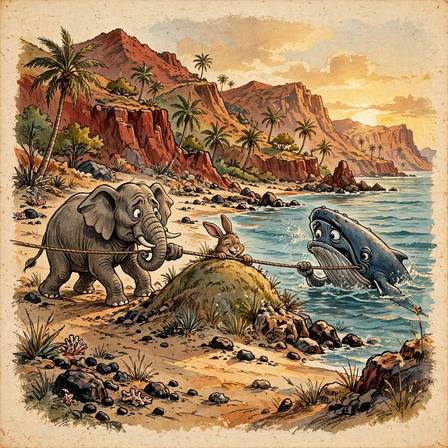
The Tug-of-War. Little Rabbit ties one rope around Elephant's belly and the other end around Whale's tail, and sits back laughing while the two giants pull against each other — each certain the rabbit is dragging him. Afterwards Rabbit hides in a horse's skull, and Elephant has never come back to this day.
The Race. Porpoise, the fastest fish in the sea, is beaten by two scallops and a relay; and Turtle outruns Goat-Gazelle over twenty miles, calling out at every five — which is why the turtle still comes ashore to lay her eggs, and watches for Goat-Gazelle when she does.
Are Monkeys People? A monkey wife is sure that hands, feet and a face make her people. One trip to town, and the children's shouting, teach her otherwise; the cliffs are home after all.
The Worn-Out Animals. A horse, a dog, a cat and a rooster, each turned out by his master for growing old, find a robbers' house in the night and frighten the robbers off — and the one robber who goes back tells the tallest tale of all about what met him inside. The scuffle is the book's own slapstick: scratches, a caught calf, a kick, and no worse.
Dividing the Cheese. Two cats steal a cheese and take it to a monkey to divide fairly. He weighs, he nibbles the heavy side to even it, he weighs again — and the cats learn what his fairness costs.
Eggs or Beans. Wolf leaves a dozen eggs unpaid, and twelve years later the bill has hatched into seven thousand chickens and twelve thousand dollars. In court, his friend Demon defends him with one question: if cooked eggs can hatch, why should cooked beans not sprout? The threats in the courtroom are the book's own dialogue, unacted, as printed in 1923.
What stands around these six is not hidden. Much of Parsons' collection is the Wolf-and-Nephew trickster cycle, and a great many of those tales turn on killings, beatings and burnings; under this library's standing rule they are excluded, not softened, and the shelf makes no claim to the whole collection. Part 1 tells the tales that stand clean.
Chapters
00:14 The Tug-of-War
03:04 The Race
05:13 Are Monkeys People?
07:28 The Worn-Out Animals
11:00 Dividing the Cheese
12:24 Eggs or Beans
From Folk-Lore from the Cape Verde Islands (1923) by Elsie Clews Parsons — public domain. The tales were collected from Cape Verdean tellers in New England; the Creole texts printed beside the English are not read here. Music: gentle instrumental bed under the narration.
KacheliTV — world classics, read aloud.
🔊 Listen to the podcast: https://rss.com/podcasts/kachelitv/
