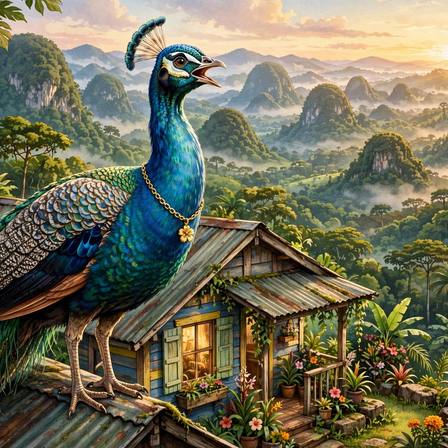
KacheliTV returns to Jamaica, and to Martha Warren Beckwith's Jamaica Anansi Stories of 1924 — tales Jamaican storytellers told her, their names kept. Part Six opens the book's second country, the Old Stories, Chiefly of Sorcery, and takes its gentle stretch: exchange and riddle tales, a wish that turns a tree into a wife, a threat defeated by a name carried home in song, two pea-fowl messengers, a ferryman's lesson, and a little fish sung back to the river whole.
Disclosure: this performance is narrated by AI-generated voices.
In "The Pea That Made a Fortune" one planted pea climbs a chain of exchanges — horn, fish, moreen, whip, cow — into riches. "Settling the Father's Debt" is settled on a boy's riddle-answers. "The Tree-Wife" grows from a hunter's wish and is sung home on the road of her own spittle. In "Grandy-Do-An'-Do" a very bad woman's threat is beaten by a name Crab gives and a song keeps. "John Studee" and "Contavio" send the pea-fowl flying from house-top to house-top as messenger. "Crossing the River" teaches a greedy boy the ferryman's price. And in "Fish, Fish, Fish" a caught fish is sung up again, whole, and put back in the river.
One passage stands as told, in a single summary clause: in "Fish, Fish, Fish" the caught fish is cooked for the family's dinner — ordinary meat-taking, kept at source weight — before the daughter's song brings all of him up again and turns him back into a big fish. Every tale of this stretch was read in full at this shelf's gate. Held for a ruling, and not read here: "Asoonah," whose single shot is the hinge of its tale. Excluded at the gate, recorded plainly, each turning on an enacted killing: "Mr. Lenaman's Corn-Field"; "Simon Tootoos"; "Sammy the Comferee"; "Grandy-Do-An'-Do" in its first telling; "Jack and Harry"; "The Barking Puppy"; "The Singing Bird," both tellings; "Two Sisters"; "The Greedy Child" in its second telling; "Alimoty and Aliminty"; "The Fish Lover," first and third tellings; "Juggin Straw Blue"; "The Witch and the Grain of Peas"; "Bosen Corner"; "The Three Dogs," both tellings; and "Andrew and His Sisters." No completeness is claimed for this stretch of the book.
The book's storytellers, kept with honour: Etheline Samuels of Claremont ("The Pea That Made a Fortune"); Simeon Falconer of Santa Cruz Mountains ("Settling the Father's Debt"); Thomas White of Maroon Town ("The Tree-Wife"); Julia Gentle of Malvern ("Grandy-Do-An'-Do"); Matilda Hall of Maroon Town ("John Studee"); Oliver D. Witter of Santa Cruz Mountains ("Contavio"); George Barrett of Maroon Town ("Crossing the River"); and Florence Thomlinson of Lacovia ("Fish, Fish, Fish").
Chapters:
00:32 The Pea That Made a Fortune
01:35 Settling the Father's Debt
03:30 The Tree-Wife
05:44 Grandy-Do-An'-Do
07:54 John Studee
10:32 Contavio
11:56 Crossing the River
12:50 Fish, Fish, Fish
Source: Martha Warren Beckwith, Jamaica Anansi Stories, Memoirs of the American Folk-Lore Society, Vol. XVII (1924) — the tales told by the Jamaican storytellers credited above; public-domain 1924 edition (Project Gutenberg eBook #72735). Our telling is a fresh in-house rendering of the 1924 text. Music: gentle instrumental bed under the narration.
Thank you for listening — with Part Six the Old Stories open; the Jamaican tales continue on this shelf.
🔊 The KacheliTV podcast carries a new world folk tale every day — follow the show so the next story finds you.
Jamaican folk tales, Anansi stories, Jamaican folk tales audiobook, Jamaican folklore, Martha Warren Beckwith, Caribbean folk tales, world folk tales, free audiobook
