Part Five of Folk Tales of the Netherlands continues William Elliot Griffis's Dutch Fairy Tales for Young Folks of 1918 in our own telling, with the book's ninth tale, in his order. (Parts One to Four carried tales one to eight; the Dutch tales are read here part by part — this is not the whole book. The ninth tale stands alone in this part, and Part Six opens with the book's tenth tale.)
Disclosure: this performance is narrated by AI-generated voices.
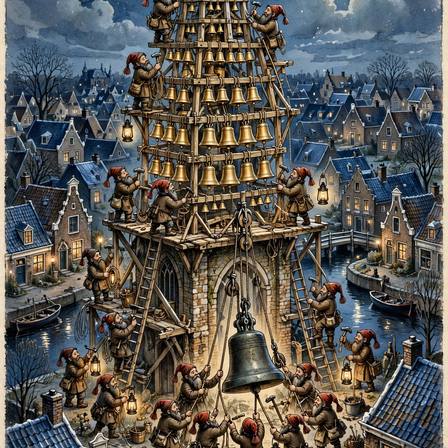
The Kabouters and the Bells — the kabouters, the dark little miners of forest and mine, no taller than a yardstick, resolve to help the good teachers who have come into the land: the rough ones find sour bread, turned beds and gravel down the chimney, but the kind ones wake to bread sweet and in plenty, gardens planted and hard work done for them. When the teachers long for church bells they are too poor to buy, the whole kabouter nation goes underground for days and weeks, mines and smelts the copper and tin, casts a hundred bells from boomers to tinklers, tunes them by the scale of their own singing voices, fathers and mothers and babies in a row, and hangs a whole carillon in the bishop's new spire in a single night, finishing before the first ray of sun can strike them. That, says Griffis, is why the Netherlands is still, above all others, the home of the carillon. In keeping with this shelf's practice, the tale stands as Griffis told it: the kabouters' plaguing of the rough teachers stands in his comic summary, the overnight felling of the forest trees in one summary passage with the holy trees spared, the storms that destroyed houses and upset boats in the one reported clause that tells why the bells were needed, and the kabouters' turning to stone in sunlight as the book's telling of their nature, for no sunbeam strikes one in the tale; no completeness is claimed beyond what is read here.
Chapters:
00:10 — The Kabouters and the Bells
Source: William Elliot Griffis, Dutch Fairy Tales for Young Folks (New York: Thomas Y. Crowell Company, 1918), from the public-domain 1918 edition (Project Gutenberg eBook #7871). Griffis retold these tales in his own English; our telling is a fresh in-house rendering of his 1918 text. Music: gentle instrumental bed under the narration.
Thank you for listening — Part 6 of the Dutch tales follows on this shelf.
🔊 The KacheliTV podcast carries a new world folk tale every day — follow the show so the next story finds you.
