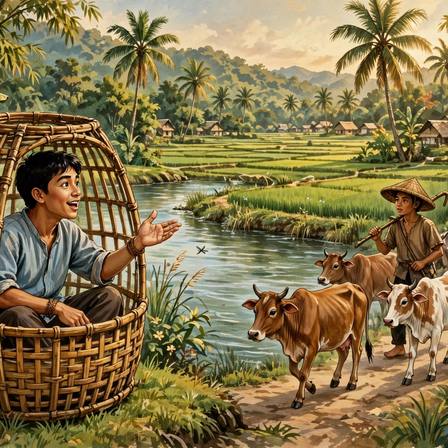
Part 9 of Folk Tales of the Philippines is the book's twentieth tale whole — the four tellings of the Master Cheat that stand around the one read in Part 8, brought together here as told, in the book's own order.
Disclosure: this performance is narrated by AI-generated voices.
In "How Salaksak became Rich," the younger brother's cowhide and ashes tricks make him rich, while his elder brother Cucunu, copying him, is whipped twice and burns his own house. Told by Lorenzo Licup, a Pampango from Angeles, Pampanga. In "Clever Juan and Envious Diego," Juan's feigned-resurrection trick and his carabao hide make his fortune, and his envious brother begs for the same road at the end. Told by Pablo Anzures, a Tagalog from Manila. In "The Two Friends," poor Andres sells an "enchanted" hide and grows rich, while rich Juan copies him at terrible cost. Told by Tomas V. Vargas, of Iloilo. In "Juan the Orphan," a boy whose uncle killed his horse turns the horse-meat, a sack, and a river into his inheritance. Told by Leopoldo Uichanco, a Tagalog from Calamba, La Laguna.
A word on these tales, told plainly. The Master Cheat cycle ends, in each of these four tellings, in drownings, and they are named here as the tales' own machinery: an innocent young man shut in Salaksak's cage and thrown into the river, and Cucunu following him down; a Chinese peddler shut in Juan's box and thrown into the ocean, and Diego following him down; a cowherd shut in Andres's sack and thrown into the sea, two mothers killed, and Juan following the cowherd down; and a muzzled dog in Juan's sack, and Uncle Diego, bound in a sack, hurled into the river at midnight by Juan's own hands. In Part 8 these four tellings stood held at this collection's gate for that machinery. On 19 October 2026 the collection's owner ruled the four in by name, to be built as told, with the drownings disclosed plainly, as here; they are read whole, at the book's own weight, neither cut nor softened. The fifth telling stands in Part 8, as before. Tale 17 remains held, untouched. One period term of address in the second telling is given in a neutral modern rendering; the book's footnote markers are kept out, and its comparative notes stand in the book, unread here.
The book's storytellers, kept with honour: Lorenzo Licup ("How Salaksak became Rich"); Pablo Anzures ("Clever Juan and Envious Diego"); Tomas V. Vargas ("The Two Friends"); Leopoldo Uichanco ("Juan the Orphan").
Chapters:
00:32 — How Salaksak became Rich
06:07 — Clever Juan and Envious Diego
11:16 — The Two Friends
17:10 — Juan the Orphan
Source: Dean S. Fansler (ed.), Filipino Popular Tales, Memoirs of the American Folk-Lore Society, Vol. XII (1921) — the tales written down in English by the Filipino narrators credited above; public-domain 1921 edition (Project Gutenberg eBook #8299). The collectors' notes stand in the book, unread here. Our telling is a fresh in-house rendering of the 1921 text. Music: opening and closing theme, "The Cello's Unfinished Promise".
Thank you for listening — the Philippine tales continue on this shelf.
🔊 The KacheliTV podcast carries a new world folk tale every day — follow the show so the next story finds you.
