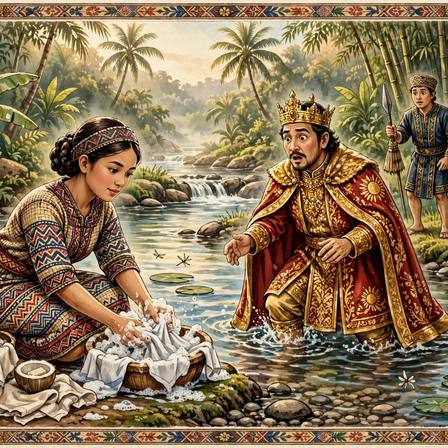
Part 3 of Folk Tales of the Philippines is a contest of wits, twice over, and then a contest of strength: a servant's daughter who answers a king's impossible errands until he has nothing left to ask; a palace servant who out-riddles his king with a rope of sand and a squash in a jar; and a lazy woodcutter who wins a golden carriage by kindness, and a princess by the four most extraordinary friends in the islands.
Disclosure: this performance is narrated by AI-generated voices.
In "Sagacious Marcela," the king demands twelve dishes from one tiny bird, a sheep sold for six reales that must still come back to him alive, and a cup of bull's milk as medicine — and Marcela answers each absurdity with one of her own, until the king gives her his son. Told by Lorenzo Licup, a Pampangan. In "King Tasio," Juan the servant is ordered to catch the waves of the sea and to make fifty dishes from a small bird; banished from the palace ground, he rides back onto it on earth from his own orchard, and the squash he grows inside the king's jar leaves the king in a faint. Told by Leopoldo Faustino, a Tagalog, who says the story is popular and common among the people of La Laguna province. And in "Lucas the Strong," the laziest of three brothers is the only one kind to an old leper woman on the mountain, and is rewarded with the golden carriage — then gathers Runner, Sharpshooter, Farsight, and Blower on the road, and wins the race for the water of youth against the king's own giant. Told by Paulo Macasaet, a Tagalog, who heard the story from a Tagalog farmer.
A word on the road here, told plainly. Between "King Tasio" and "Lucas the Strong" the book places five tales that stand held at this shelf's gate for a ruling, and are not read here: "The Story of Zaragoza," "Juan the Peerless Robber," "The Seven Crazy Fellows," and the two tellings of the magic charm, "Juan Manalaksan" and "Juan the Poor, who became Juan the King." In the tales that are read: Marcela's pig is killed in a single clause, off the page, its blood a named prop in her answer to the king; Lucas's strength comes from the tip of a boa's tail, bitten off in one brief passage, the snake left alive; and the king's threat that Lucas shall lose his head if he loses the race stands as words only, never approached. The wrestling on the road is friendly contest, with agreed stakes, and no one is harmed. No completeness is claimed for this stretch of the book.
The book's storytellers, kept with honour: Lorenzo Licup ("Sagacious Marcela"); Leopoldo Faustino of La Laguna ("King Tasio"); Paulo Macasaet ("Lucas the Strong").
Chapters:
00:10 — Sagacious Marcela
04:05 — King Tasio
07:07 — Lucas the Strong
Source: Dean S. Fansler (ed.), Filipino Popular Tales, Memoirs of the American Folk-Lore Society, Vol. XII (1921) — the tales written down in English by the Filipino narrators credited above; public-domain 1921 edition (Project Gutenberg eBook #8299). The collectors' notes stand in the book, unread here. Our telling is a fresh in-house rendering of the 1921 text. Music: gentle instrumental bed under the narration.
Thank you for listening — Part 4 of the Philippine tales follows on this shelf.
🔊 The KacheliTV podcast carries a new world folk tale every day — follow the show so the next story finds you.
