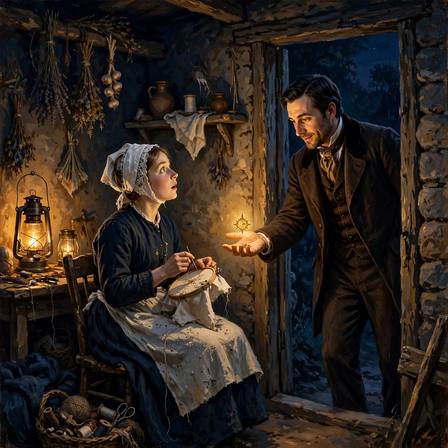
Four more tales from the Diableries of Upper Brittany: a seamstress who outwits the devil by forgetting nothing that matters, a shroud that cries out to be given back, and two assemblies of cats that no wise man disturbs. Before them in the book stands tale XLVII, the tale of the werewolf, which stands held for a ruling; and among them stands tale L, the Devil Fiddler, which waits for a legible leaf of the book. No completeness is claimed for the stretch.
Disclosure: this performance is narrated by AI-generated voices.
In Rodomont, Marie Mariton, a seamstress so plain that no one has ever thought of courting her, is offered a charm by a courteous gentleman: it will make her beloved see no one but her — if in a year's time she can still tell him his name. The birds of the fields sing the name back to her husband on the eve of the reckoning. The book appends to the tale a little tale of Ille-et-Vilaine of the same pattern, in which a sprite spins a loft of hemp for the wife who must guess his name, or be carried off. The tales stand as Sébillot told them: the signing of the pact in her blood is the book's one clause, and the husband's threat in the little tale is the book's one clause likewise — spoken, and never done; no other harm is done or suffered in the telling.
In The Funeral Sheet, a seamstress carries a shroud home from a grave, and all the way a voice cries after her: give me back my shroud. She carries it back by night, as the priest bids her, and sews into the cloth the death's head that settles upon it. The book tells in a single clause that she died of her fright on the spot; the clause is carried whole, exactly as the book gives it, and no completeness beyond the book's own telling is claimed for it.
In The Sorcerer Cats, the book's opening tells, as the talk of the evening gatherings tells it, that some who meddled with the cats' assemblies died suddenly, and others' hair whitened in a night; it is the book's one reported clause, carried whole. Jean Foucault, coming home from the fair and singing, finds the assembly seated round a stone cross — and is let pass by the one cat he knows. In The Dance of the Cats, a thresher who frightens the cats at a crossroads, for a joke, is held dancing in their midst until his own words set him free, and the nails are danced out of his shoes.
Rodomont was told in 1878 by Jeanne Bazul, of Trélivan, and its companion tale by Jean Piou, of Gosné, aged thirteen. The Funeral Sheet was told in 1879 by the young Frostin, of Saint-Cast, aged about fourteen. The Sorcerer Cats was told by Émile Frostin, of Matignon, in 1863. The Dance of the Cats was told by Angèle Quérinan, of Andouillé, in 1878.
Told in Upper Brittany, and collected by Paul Sébillot (1843–1918).
Chapters:
00:09 Rodomont
08:45 The Funeral Sheet
10:41 The Sorcerer Cats
13:15 The Dance of the Cats
From Paul Sébillot, Contes populaires de la Haute-Bretagne, Tome I (Paris: G. Charpentier, 1880), public domain; told in a fresh in-house rendering from the French.
Folk Tales of France is KacheliTV's telling of Paul Sébillot's Contes populaires de la Haute-Bretagne — the great nineteenth-century collection of the tales of Upper Brittany.
🔊 Listen to the podcast: https://rss.com/podcasts/kachelitv/
