Folk Tales of France, Part Ten — four more tales from Sébillot's second Breton volume (Tome II, 1881), freshly translated; what the gate and the scan kept back is declared below.
Disclosure: this performance is narrated by AI-generated voices.
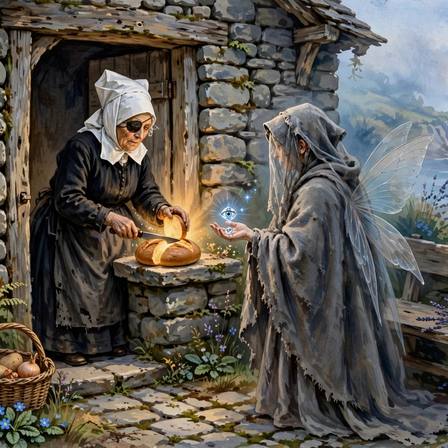
The Fairies' Bread and the Crystal Eye. A poor one-eyed woman of Saint-Cast shares her last piece with a beggar — a fairy in disguise, who pays her with a loaf that never diminishes and a crystal eye for the lost one: never tell what it sees. Her gossip's knife ends the loaf; at Matignon market the eye shows her the fairy thieving unseen, and she cries out. Told whole, as printed: the fairy tears away the crystal eye itself, in a single clause, and her parting curse names a starvation the tale never enacts.
The Houle Saint-Michel. The fairies under the hearth take Jean's pig, and pay: a purse of a hundred gold pieces — and a second when a cow follows. When his wife lies dying, a fairy rises through the hearth with a bottle she may not use herself — the mother must rub the ointment in, feet, tongue and eyes — and her son, an innocent of fifteen who has never spoken or walked, walks, speaks, reasons, and receives the fairy's wand.
The Houle of Chêlin. A slab in a flooded house lifts on the fairies' kitchen, and a woman bakes in their oven; ointment round her eyes shows her the little fions, and the baked loaf will never diminish — if only her own hand cuts it. A day-labourer's knife ends that. Told whole, as printed: at Matignon fair she sees a fairy thieving from a woman's apron, cries out, and the fairy tears out her seeing eye in the tale's single closing clause — no suffering told; she knows it only at her mirror.
The Pertuis ès Fêtes. Ploughmen above the Fairies' Cleft joke with the voices below — "Since you are baking, give us a cake for our share" — and get one full of hairs, and a second, golden, which the dog tests first. Having eaten it, they take back their threat against the fairies' dog; and the voice spares the goat about to be beaten, and makes the gorse grow again daily as fast as it is cut, till the farmers are rich on cartloads.
Tellers, as printed: Joseph Macé, Saint-Cast, cabin boy, 14; Rose Renaud, Saint-Cast, from an aged woman of Erquy; François Marquer, Saint-Cast, cabin boy, 14; Jacquemine Nicolas, Saint-Cast, about 60 — all told in 1880.
What stands around these four is accounted for, not hidden. Two passing tales wait on the book itself: La Fleur du Rocher — between the two Houles above — passes with passage notes, but its middle leaves (pp. 35–37) are absent from the only lawful scan; La Poule noire passes whole, but one leaf's lower half is illegible there. Both stand artifact-blocked, with the opening tale La Houle du Châtelet, for a later part. Tome II stands gated tale by tale: twenty-eight pass whole, twenty-six with passage notes, their matter disclosed in their parts, as here. Eleven stand stopped, held for the owner's ruling by name: La Mort des fées, La Princesse Félicité, Les Petites Coudées, Le Corps sans âme, Petite Baguette, Le Présent de la fée, La Fille aux bras coupés, La Chèvre blanche, Moitié de Coq, Les Boucs de Saint-Brieuc des Iffs, and La Biquette et ses petits biquets. Two are excluded by name: Les Trois Petites Poules, and the second printed telling of Les Sept Garçons et leur sœur. Three more wait on the book: Les Fées du Guildo, Le Meneur de loups, and Le Bélier courant in part. No completeness is claimed.
Chapters
00:08 The Fairies' Bread and the Crystal Eye
02:48 The Houle Saint-Michel
08:26 The Houle of Chêlin
12:24 The Pertuis ès Fêtes
From Paul Sébillot, Contes populaires de la Haute-Bretagne, Tome II (Paris: G. Charpentier, 1881), public domain; told in a fresh in-house rendering from the French.
Folk Tales of France is one shelf of the KacheliTV world folk tale library.
🔊 Listen to the podcast: https://rss.com/podcasts/kachelitv/
