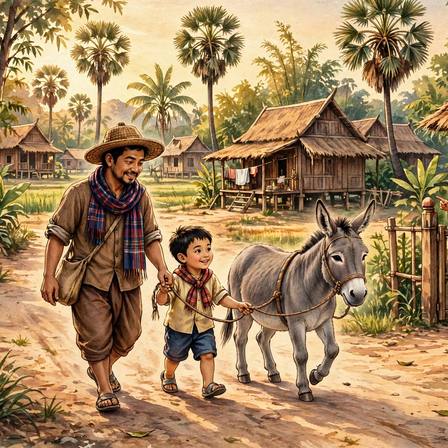
The Gatiloke continues its seventh part. A father and son, taking their fat young donkey to sell, change their way at every voice they meet — carrying it slung, the son riding, the father riding, both riding, both leading — and learn that with one donkey, pleasing the world cannot be done. Chao Chak Smok, weaving baskets at the top of a sugar palm, daydreams his way from one riel to fields and fortune, kicks at the slave girl of his dream, and falls — and the rescue that follows costs the four kind helpers who catch his fall their lives, while a poor woman's spilled pot of milk teaches the same lesson of desire-thought. And a tortoise, carried through the sky by its friends the hamsa geese, cannot keep its mouth shut over Varanasi.
Disclosure: this performance is narrated by AI-generated voices.
The episode opens and closes with Bandoneo Street Romance as its theme, heard also briefly between the stories. Narrated by Madame de Pamplemousse.
Chapters:
01:12 — The Father and Son Who Took a Donkey to Sell
15:43 — Chao Chak Smok
28:49 — The Hamsa Goose and the Tortoise
From the Gatiloke by Suttantaprija Ind (1859–1924), Cambodia's treasury of Khmer folk tales, first published in parts in Phnom Penh in 1914–1921 — public domain, and told here in a fresh in-house English rendering made from the Khmer text, in the book's own order. Earlier holds stand as recorded in the collection's written register and in the descriptions of Parts 1–15: the question-chapter of the rascal who should be feared; Bhikkhu Sok, the Pnong teacher; the Singha-To who wanted the chief's daughter; the crocodile and the cart-driver; the hunter and the parrot; the fable of the old woman whom desire unmade; the abbot and his two students; the deer, the crow and the jackal; the jackal and the elephant; the lion and the frog; the rabbit and the tigress; and the goatherd boy — each held back under house rule until it is ruled on by name. One further tale of the book's sixth part — the tale of the village cat and the chap-puk bird — is likewise held back under house rule: its matter is a killing and an eating in the tale's open scene, twice over, and such a tale is not read until it is ruled on; it stands recorded in the register, in its place. Two tales at the close of the book's seventh part are likewise held back under house rule until they are ruled on by name: the lion who loved a cow, whose matter is a poisoning plotted and done, upon a tale of desire; and the monkey and the great hermit, whose matter is a sexual act done by guile on an unwilling other, as the tale's whole engine. The book's earlier item in this part, the tale of the man who knew how to play the gong, has no text in the collection's transcription as it stands; its collation is still owed, and it was passed in its place.
KacheliTV — world classics, read aloud.
