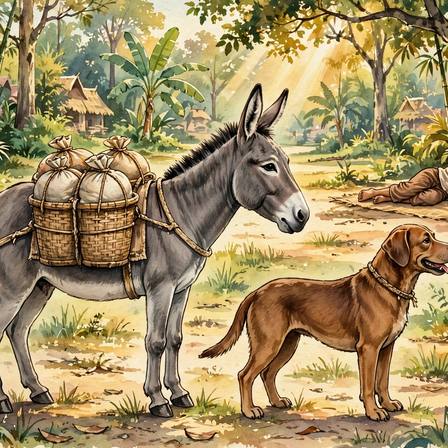
The Gatiloke closes its sixth part and opens its seventh. A donkey laden with his master's stores refuses the hungry dog a midday share of rice, for the stores are not his to give; when a wild dog chases him, the dog returns his own words and sits watching — until the master wakes, and judges the fault to be his own. The feet, the hands and the mouth, learning that all their labour feeds a stomach that does no work, go on strike together, and wither together, and learn why the idle centre must be fed. A bitch at a charnel ground talks her pup out of eating a corpse, part by part — eyes, ears, nose, mouth, hands, feet, and the mind itself — until the pup gives the wish up untouched. And a village chief, beaten twice by his servant boy's wit, receives tongues when he orders the best meat in the world, and tongues again when he orders the worst.
Disclosure: this performance is narrated by AI-generated voices.
The episode opens and closes with Bandoneo Street Romance as its theme, heard also briefly between the stories. Narrated by Violetta.
Chapters:
01:17 — The Donkey and the Dog with the Same Master
14:09 — The Feet and Hands That Envied the Mouth
22:15 — The Bitch and the Corpse
31:08 — The Village Chief and His Servant Boy
From the Gatiloke by Suttantaprija Ind (1859–1924), Cambodia's treasury of Khmer folk tales, first published in parts in Phnom Penh in 1914–1921 — public domain, and told here in a fresh in-house English rendering made from the Khmer text, in the book's own order. Earlier holds stand as recorded in the collection's written register and in the descriptions of Parts 1–14: the question-chapter of the rascal who should be feared; Bhikkhu Sok, the Pnong teacher; the Singha-To who wanted the chief's daughter; the crocodile and the cart-driver; the hunter and the parrot; the fable of the old woman whom desire unmade; the abbot and his two students; the deer, the crow and the jackal; the jackal and the elephant; the lion and the frog; the rabbit and the tigress; and the goatherd boy — each held back under house rule until it is ruled on by name. One further tale of the book's sixth part — the tale of the village cat and the chap-puk bird — is likewise held back under house rule: its matter is a killing and an eating in the tale's open scene, twice over, and such a tale is not read until it is ruled on; it stands recorded in the register, in its place. The book's next item after this part's tales, the tale of the man who knew how to play the gong, has no text in the collection's transcription as it stands; its collation is still owed, and Part Sixteen opens at the tale after it.
KacheliTV — world classics, read aloud.
