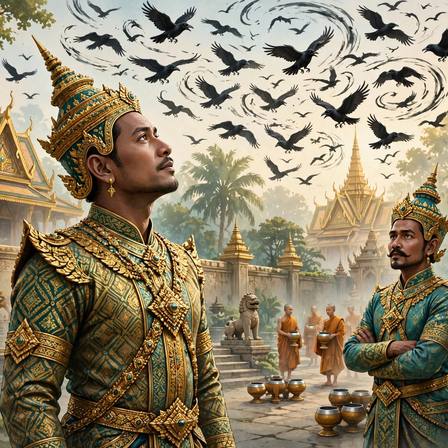
The Gatiloke stays in the book's sixth part. A prisoner under sentence of death, who claims a knowledge no one else alive possesses — the language of animals — begs his life from the great lord who would learn it, in the Buddha's own hall; and when his secret release is laid against that lord before the king, on a morning when the crows clamour over the palace, the lord answers the charge by reporting what the crows are saying. A sampoch creeps into a rice barn and eats until it is too fat to leave by the gap it came in at, and wins its freedom only by fasting itself thin again. And a merchant's laden donkey, beaten and dragged away by the forest robbers, learns that the goods upon its back were the whole cause of its suffering; a woman in Phnom Penh, struck by a robber feigning her husband and stripped of her gold while no one helps, learns the same.
Disclosure: this performance is narrated by AI-generated voices.
The episode opens and closes with January Lament as its theme, heard also briefly between the stories. Narrated by Scratch.
Chapters:
00:57 — Oknha Yomaraja and Oknha Poltep
19:23 — The Sampoch That Got into the Rice Barn
22:38 — The Donkey-Seller and the Forest Robbers
From the Gatiloke by Suttantaprija Ind (1859–1924), Cambodia's treasury of Khmer folk tales, first published in parts in Phnom Penh in 1914–1921 — public domain, and told here in a fresh in-house English rendering made from the Khmer text, in the book's own order. Earlier holds stand as recorded in the collection's written register and in the descriptions of Parts 1–13: the question-chapter of the rascal who should be feared; Bhikkhu Sok, the Pnong teacher; the Singha-To who wanted the chief's daughter; the crocodile and the cart-driver; the hunter and the parrot; the fable of the old woman whom desire unmade; the abbot and his two students; the deer, the crow and the jackal; the jackal and the elephant; the lion and the frog; the rabbit and the tigress; and the goatherd boy — each held back under house rule until it is ruled on by name. One further tale of the book's sixth part — the tale of the village cat and the chap-puk bird — is likewise held back under house rule: its matter is a killing and an eating in the tale's open scene, twice over, and such a tale is not read until it is ruled on; it stands recorded in the register, in its place.
KacheliTV — world classics, read aloud.
