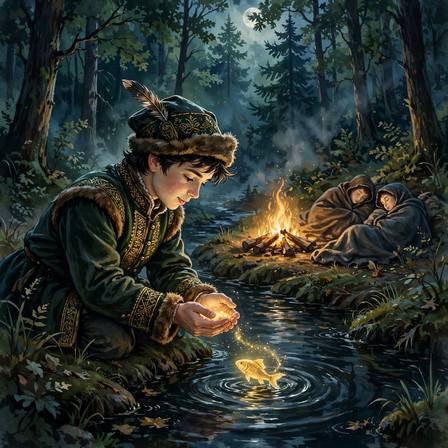
A dying king charges his three sons to wear new boots every blessed day — and the charge beggars them, exactly as the youngest, Pengő, insists their father intended, so that they must wander out and see the world. Three arrows choose three night camps: a monstrous wild boar with tusks of pure gold; a great eagle-vulture swooping out of the high heavens; and, on Pengő's watch, a little golden fish stranded in a dried-up stream, who gives him two golden scales for her life. Fetching fire in the night, he ties Midnight and Dawn to trees to make the hours wait, turns the twelve giants' roasting ox on its spit with his little finger, and shoots the rooster down off the black castle's wall — and when the giants squeeze one by one through the hole in the wall, each loses his head to his sword, in the single summarizing sweep in which Benedek tells it.
Disclosure: this performance is narrated by AI-generated voices.
The castle is won, the tokens are carried out of the sleeping palace, and the three brothers marry the three princesses at the king's storytelling inn. But the span-high man — pulled out of the mud by Pengő alone of the three brothers — repays the kindness by snatching Pengő's wife away in his seven-ell beard. The road after her runs by the wise man who has sat a hundred years on his rock, and through the diamond castle, where Pengő will not touch the black food though they beat him down for it two days running, and lashes the witch's horse-maidens until his whip strikes the wasp she rides among them. It ends at the golden stream, where the golden stag, the lamb, the duck and the beetle fall one after another, each in its clause, and the span-high man crumbles to dust and ashes before their eyes.
The tale is told whole, as Benedek wrote it: the giants in one summarizing sweep, as told above, and every other hard passage at the source's own weight — the two beasts of the first nights in a clause apiece, the beatings in a clause apiece, the lash aimed at the wasp, and the strength that lived in beast after beast destroyed link by link.
From Benedek Elek, Magyar mese- és mondavilág (Athenaeum, 1894–96), public domain; told in a fresh in-house rendering.
KacheliTV — world classics, read aloud.
