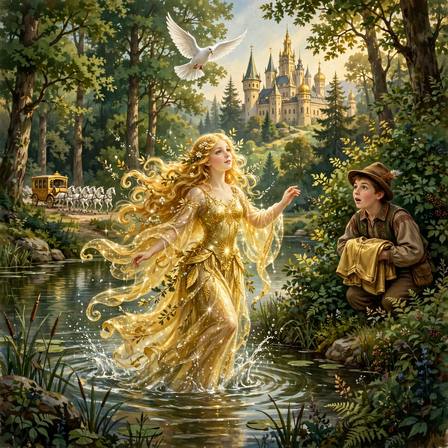
The youngest of three poor brothers serves out his year honestly, and his bushel of wages comes up pure gold — until a woodpecker snatches one golden ear and he chases it into the deep forest, to sleep the night in a giant's coat-sleeve and wake as the giant's adopted son. Wanting to marry, he is sent to the round lake, where Fairy Elizabeth comes at noon as a white dove, and he takes her golden garment from the bank; the giant sews it into a walnut, and the walnut into his waistcoat pocket, and she comes for it in a coach with six horses, and the wedding is written into the dust. The tale is told whole, as Benedek wrote it: the homecoming to the thirtieth death-feast held for him, the mother's sleeping-draught and the cut pocket, Elizabeth dancing in her girlhood garment and rising as a white dove from the pear tree, and the long road after her — the giant's undividable mace, the king of the creeping creatures, the old woman's three whip-cracks under the millstone, the lame woodpecker who alone knows the way — to the land of Black Mourning and the city of Johara, and the golden tub that gives him back his youth.
Disclosure: this performance is narrated by AI-generated voices.
Two horses die of the long roads in a clause apiece along the way, as the old tale tells it; nothing here is enacted, and no one in the tale is harmed.
From Benedek Elek, Magyar mese- és mondavilág (Athenaeum, 1894–96), public domain; told in a fresh in-house rendering.
KacheliTV — world classics, read aloud.
