The Fables of Ivan Krylov — Episode Twenty-Eight
Disclosure: this performance is narrated by AI-generated voices.
Five fables by Ivan Krylov (1769–1844), in new English verse translations made for this show, read aloud over a gentle instrumental bed.
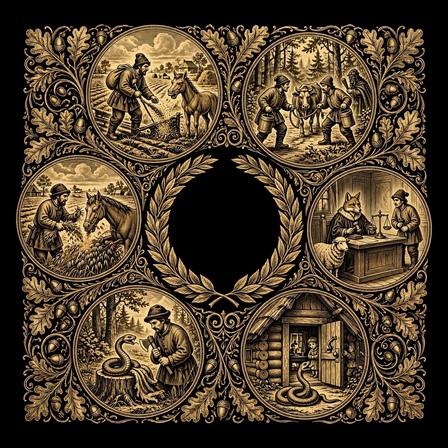
The Peasant and the Horse (Крестьянин и Лошадь, Book VIII, No. 3) — A Peasant sows his field with oats, and the young Horse, watching, grumbles at the waste: he might have fed the grain to her, or to the hens — but scattering it in the dirt is sheer stupidity. By autumn those very oats are harvested, and the Peasant feeds them to that same Horse. Krylov's closing address to the Reader asks whether man, in his blind conceit, does not judge the will of Providence in exactly the same way.
The Peasant and the Robber (Крестьянин и Разбойник, Book IV, No. 14) — Setting up his household, a Peasant buys a cow and a milk pail at the fair and walks quietly home through the grove — straight into a Robber, who strips him like a lime tree. The Peasant weeps: a whole year he saved for that cow. The Robber, softening, shows his pity in the only way he knows: he has no cow to milk himself, so the Peasant may have his milk pail back.
The Peasant and the Sheep (Крестьянин и Овца, Book VII, No. 17) — A Peasant brings a criminal charge against a Sheep: two of his hens are missing, only bones and feathers remain, and the Sheep alone was in the yard. The Sheep answers that she slept all night, calls her neighbours as witnesses, and notes that she never eats meat at all. Judge Fox delivers her verdict word for word — a verdict in which the Sheep's very presence beside those tasty hens is proof enough, and the meat goes to the court while the skin goes to the plaintiff.
The Peasant and the Snake, from Book Four (Крестьянин и Змея, Book IV, No. 13) — A Snake asks a Peasant to take her into his house — not to live idly, but to nurse his children, for bread tastes sweetest when it is earned. She knows the evil fame of snakes, but she is the kindest of them all: she has never bitten anyone and would gladly have her sting torn out. The Peasant refuses: let one good Snake be welcomed, and a hundred evil ones will crawl in after her and ruin all the children. The very best of snakes, he says, is fit for nothing at all.
The Peasant and the Snake, from Book Six (Крестьянин и Змея, Book VI, No. 16) — A different fable with the same title. A Snake crawls in to a Peasant and proposes friendship: there is no need to fear her now, for she has become quite different — she changed her skin this very spring. The Peasant is not persuaded. He seizes an axe-helve: though you are in a new skin, your heart is still the same. Krylov's closing moral is for everyone who changes a disguise after giving men cause to lose their faith.
Krylov Fables.
KacheliTV — Russian classics, read aloud.
