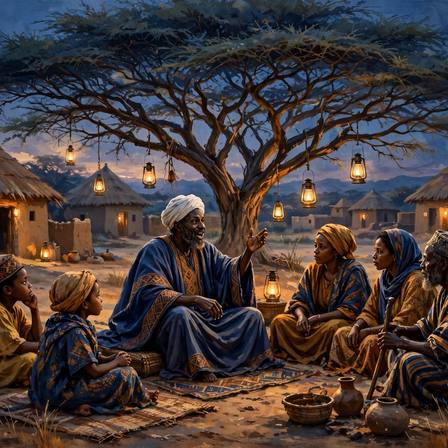
Folk Tales of the Hausa People — Part 1 (The Orphan · Miss Salt, Miss Pepper · The Beautiful Maiden and the Hartebeest · The Three Youths)
Disclosure: this performance is narrated by AI-generated voices.
Part one — the premiere of a new shelf. Four folk tales of the Hausa people from R. Sutherland Rattray's Hausa Folk-Lore (1913) — the tales of Maalam Shaihu, collected, transliterated and translated by Rattray — heard in Rattray's English exactly as he printed it. In The Orphan, a dying mother leaves her daughter in trust to her fellow wife; the stepmother's cruelty — the sick girl left standing with the water-pot on her head while task after task is found — ends when the wind carries the maiden to the hut of the thigh-bone and his interpreter the dog, whose single grains of rice and corn test her patience and raise her above her persecutors; and when the stepmother sends her own daughter down the same road, the harvest is envy itself: he who sows evil, it comes forth in his own garden. In Miss Salt, Miss Pepper, Salt, Daudawa, Spice, Onion-leaves and Pepper set out to visit the beautiful youth Daskandarini; only despised Daudawar-batso, who follows behind because she smells, will stop to rub the old woman's back at the stream — and she alone learns the youth's name, and is raised up as mistress over them all. In The Beautiful Maiden, a chief offers his daughter to whoever hoes furthest and runs fastest, and the chameleon wins both — riding his magic hoe, then riding the hartebeest's tail as a needle — which is why the hartebeest's eyes bear the marks of tears to this day. And in The Three Youths, the king of prayer, the prince of bowmen and the king of wrestlers, carrying their maidens home, find the stream risen: prayer parts the water, arrows bridge it, and the wrestler leaps it in a wrestling throw. The episode opens and closes with its theme, Imperial Violin Masquerade, heard also briefly between the stories.
Chapters
0:38 The Orphan, Showing That He Who Sows Evil, It Comes Forth in His Own Garden
15:39 Miss Salt, Miss Pepper, and the Rest
23:08 The Beautiful Maiden, and How the Hartebeest Got the Marks under Its Eyes Like Teardrops
25:48 The Three Youths, and How They Used Their Skill to Circumvent a Difficulty
The remaining tales of Rattray's two volumes are not read in this part. Held for the owner's ruling by name: The World · How the Whip and the 'Maara' Spoon Came to the Haunts of Men · The Doctor Who Went a Pilgrimage to Mecca on a Hyena · The Orphan of the Coat-of-Skin Saying · A Jealous Man and What Befell Him · A Great Friendship, and How It Was Put to the Test · Muusa (Moses) · The Spider and the Crows. Excluded by name: How Brothers and Sisters First Came to Quarrel · The Boy and the Old Woman, and the Wasp · A Chief, and How His Sons Observed His Funeral · A Witch, and How the Baby of the Family Outwitted Her · A Chief and His Cook · A Hunter and His Son · A Maiden and the Pumpkin · The Gawo-Tree and the Maiden · The Water of Ladi · The Lizard and the Hyena · The Beetle, and How He Got His Thatching Done · The Spider and the Lion · The Spider and the Dodo. Standing on the bench for later parts of this shelf: A Test of Skill · A Giant, and the Cause of Thunder · The Spider, the Hippo, and the Elephant · The He-Goat · The Lion and the Leopard. No claim of completeness for Rattray's book is made.
From Hausa Folk-Lore, Customs, Proverbs, Etc., by R. Sutherland Rattray (Oxford, 1913), public domain — the tales of Maalam Shaihu in Rattray's English translation as printed; this is his translation, not a new one. Narrated by Scratch. Theme: Imperial Violin Masquerade.
KacheliTV — world classics, read aloud.
