KacheliTV opens a new shelf: the Baloch people of the Indus frontier, in tales M. Longworth Dames collected in the Dera Ghazi Khan district and published in Folk-Lore in 1892–93 — contests of wit and strength and one of the great absurdity chains in world folklore.
Disclosure: this performance is narrated by AI-generated voices.
In this part:
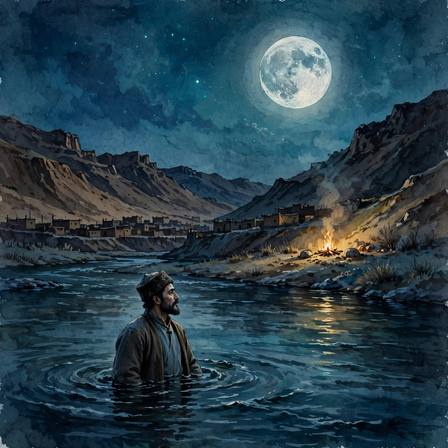
The Man Who Stood All Night in the River — A king offers his daughter to whoever can stand a whole winter's night in the river. One man survives, his heart fixed on a distant fire — only to be refused on a point of logic. The princess turns the king's argument against him, with a griddle on the housetop and a fire in the yard.
The Two Wrestlers — A wrestler of Shikarpur travels to Dera Ghazi Khan to challenge its champion, and is undone before they meet by the champion's daughter carrying in a "dead rat" on a spear-point: a young elephant. The match is held on a clod of earth on an old woman's palm.
The Four Men Who Made the Figure of a Woman — On four night watches a wooden figure is shaped by the carpenter, clothed by the Darzi, jewelled by the goldsmith, and given breath by the Saiyid's prayer. At dawn all four claim her; the king's judgment turns on custom: it is the bridegroom who gives clothes to the bride.
The Clever Lad — A king's discarded wife raises her son by the highway. When the king proclaims a palace to be built with the sky for its foundation, the lad takes the commission; on the road he hides three riddles in talk a king calls madness — read at once by a king's daughter. The first brick must be laid by a man who has never committed a fault — and the search brings the story home.
The Three Fools — Three foolish Baloches quarrel over which of them a passing horseman salaamed. His answer — "the biggest fool of you" — sets them confessing: the door neither husband nor wife would speak first to shut, the white hair that cost a man every hair on his head, and the cowherd who paid a whole herd for a wife and child never seen.
The Three Wonderful Gifts — Three brothers trade with their uncle's three hundred rupees for a bride: a bead that revives the dead, a flying couch, and a looking-glass that sees a hundred miles. When the glass shows the bride lying dead, the three gifts must work together, and the king must decide which brother earned her.
Kismat Pari — A prince falls silent for love of Kismat Pari, glimpsed bathing in a garden pond. A faqir's pointing hand sends him eight days' journey to her bed; she has vowed to marry whoever comes to lie upon it, but her parents refuse a mortal, and the case goes up before the Prophet. The lovers are left wandering the world in search of each other.
Chapters:
The Man Who Stood All Night in the River — 0:39
The Two Wrestlers — 2:37
The Four Men Who Made the Figure of a Woman — 6:33
The Clever Lad — 8:33
The Three Fools — 14:50
The Three Wonderful Gifts — 20:52
Kismat Pari — 23:37
Source: Folk Tales of the Baloch People (Balochistan) — Balochi Tales, collected and translated by M. Longworth Dames, Folk-Lore, 1892–93. Public domain; read as printed, in English. Dames's spellings (Balochi, Baloches) stand as printed; the shelf bills the people as Baloch.
Nine of Dames's nineteen tales are set aside under the channel's rules (among them The Tiger and the Fox, Balach and the Bulethis, Shah-Jehan and Aurangzeb); three more — The King who had a Boil on his Face, The King and the Four Thieves, and The Abduction of Samri — are held for a ruling. No completeness is claimed.
Narrated by Benedetto.
Theme: Imperial Violin Masquerade — opening, closing and separators only.
