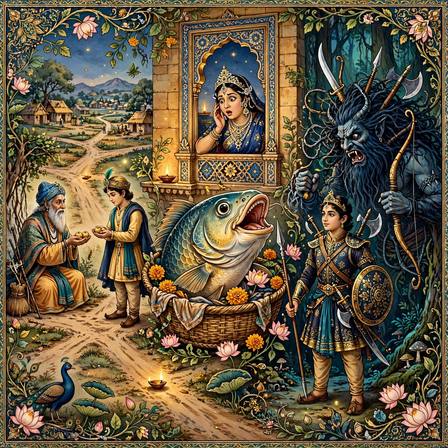
Three tales from Joseph Jacobs' Indian Fairy Tales. In the first, a childless king lies down where four roads meet so that all must step over him, and a fakir's blessing gives him two sons — but the fakir returns in a year to claim the elder, and the prince, taken as his pupil, turns the fakir's own cauldron against him and frees everything the fakir held captive. In the second, a fish laughs aloud when a queen asks whether it is a he or a she; the king gives his vizier six months to explain the laugh, and the answer, won on the road by the vizier's son from a farmer's wise daughter, uncovers a man hidden among the palace maids. In the third, the Prince of the Five Weapons walks fearless into a demon's forest, and when sword, spear, bow, battle-axe and shield have all stuck fast in the Demon's matted hair, it is his fearlessness alone that wins him free.
Disclosure: this performance is narrated by AI-generated voices.
Stories:
00:46 The Prince and the Fakir
10:53 Why the Fish Laughed
23:47 The Demon with the Matted Hair
A note on what is not read here. Two tales that stand between these three in Jacobs' book are not read, under the shelf's standing rule that a tale-type is told once, in its strongest telling: The Farmer and the Money-Lender (Jacobs 21) is a variant of a tale this shelf tells from Flora Annie Steel's collection, and The Boy who had a Moon on his Forehead and a Star on his Chin (Jacobs 22) is a variant of a tale this shelf tells in full from Maive Stokes' collection. Both are named here and in the shelf's exclusion register, not silently dropped; the shelf as a whole makes no claim to completeness.
A note on Why the Fish Laughed. The death sentence in this tale is a threat spoken near its opening — the vizier is given six months to explain the fish's laugh on pain of death — and it is never carried out: the tale ends with the faithful vizier saved. It is read here exactly as Jacobs printed it.
From Indian Fairy Tales by Joseph Jacobs (1892), public domain; Project Gutenberg #7128 — the Panchatantra and Jataka tales Jacobs retold from the older collections, told here as Jacobs printed them. Narrated by Amos.
Music: "Falling Leaves at the Ice Cliffs" — instrumental opening and closing theme, with short instrumental separators between the stories.
KacheliTV — world classics, read aloud.
