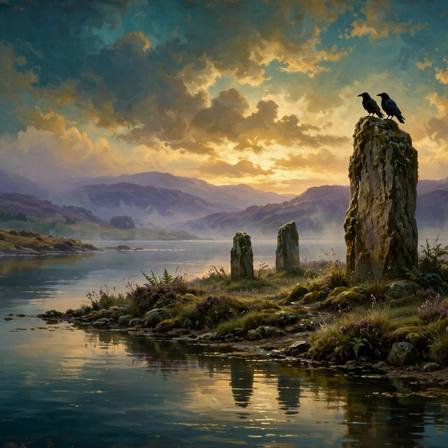
Part Two of the West Highlands tales brings the bench home: ten more tales from J. F. Campbell's Popular Tales of the West Highlands — the two fox fables Campbell's collectors brought back, the great comic tale of the Three Wise Men, the little origin-story of Loch Ness, a singing mouse, three unanswerable questions, two hoodies, and the lawsuit that made the dog-fish the king's fish.
Disclosure: this performance is narrated by AI-generated voices.
In this part:
- The Fox and the Goose — the fox invites the goose to play at grinding corn, cheek teeth against cheek teeth; the goose talks back from inside the grip, and the fox's greed finishes the lesson at the cail-wife's meal chest.
- The Fox and the Cock — the cock will not sleep alone in the hen-roost, and the fox's grinding game is played a second time — with the other ending.
- The Three Wise Men — a gentleman is sent to find three men as senseless as himself, and a deaf miller sends a scholar on the same errand from the other side: a loaf carried against the dog, daylight carried out of a doorless house in a riddle, a drowned man weighed against his wife, and a salmon too big for its boat.
- The Origin of Loch Ness — a well door left unshut, a flood out of a hillside spring, and the cry that named the loch.
- The Cat and the Mouse — a song for a ransom, in Campbell's own translation of the verse: the mouse wants a tuning fork, and the cat will not listen.
- The Three Questions — how many stars are in the lift, where is the middle of the earth, and what am I thinking: a miller answers a scholar three times, in two tellings.
- How the Cock Took a Turn Out of the Fox — the cock, carried off in the fox's mouth, talks him into talking.
- The Hoodie Catechising the Young One — a mother hoodie's whole school of safety, undone by one question about a stone in a pouch.
- The Hoodie and the Fox — a wager on who rises first, lost before the day has well begun.
- The Reason Why the Dallag is Called the King's Fish — two kings, one dog-fish, two hooks, and a lawsuit: Fionn keeps the fish, Lochlann pays the fine, and the dallag carries the king's name ever after.
What is not read: Campbell's Gaelic parallel texts are not read anywhere in this episode, and neither are his introductions, notes, footnotes, or variant apparatus. In "The Three Questions," everything printed after the tale proper — Campbell's collection note and the long riddle collection that follows — is apparatus and is not read. In "The Cat and the Mouse," only the section Campbell heads TRANSLATION is read. Two tales stand held for a ruling and are not read or touched — The Chest and Murchag a's Mionachag. Excluded by name from this shelf and not read: The Young King of Easaidh Ruadh, the Battle of the Birds, The Hen, the Barra Widow's Son, and the supplement items Gwragedd Annwn, Urashima, and the Wishing Ring frame. The Fenian lays of Campbell's fourth volume are not read in this episode. With this part, every tale the shelf's source audit passed and benched has been told across Parts One and Two; no completeness for Campbell's volumes is claimed.
Timestamps:
00:45 — The Fox and the Goose
02:53 — The Fox and the Cock
04:13 — The Three Wise Men
16:29 — The Origin of Loch Ness
17:41 — The Cat and the Mouse
18:52 — The Three Questions
21:09 — How the Cock Took a Turn Out of the Fox
22:30 — The Hoodie Catechising the Young One
23:50 — The Hoodie and the Fox
25:00 — The Reason Why the Dallag is Called the King's Fish
Source: J. F. Campbell, Popular Tales of the West Highlands (1860–62), Campbell's English as printed. Narrated by Felix. Opening and closing theme: Bandoneo Street Romance — with a short instrumental separator between stories, and no music under the narration.
KacheliTV — world classics, read aloud.
